
Beyond Chatbots: How to Build Production-Ready Autonomous AI Agents for Enterprise Workflows in 2026
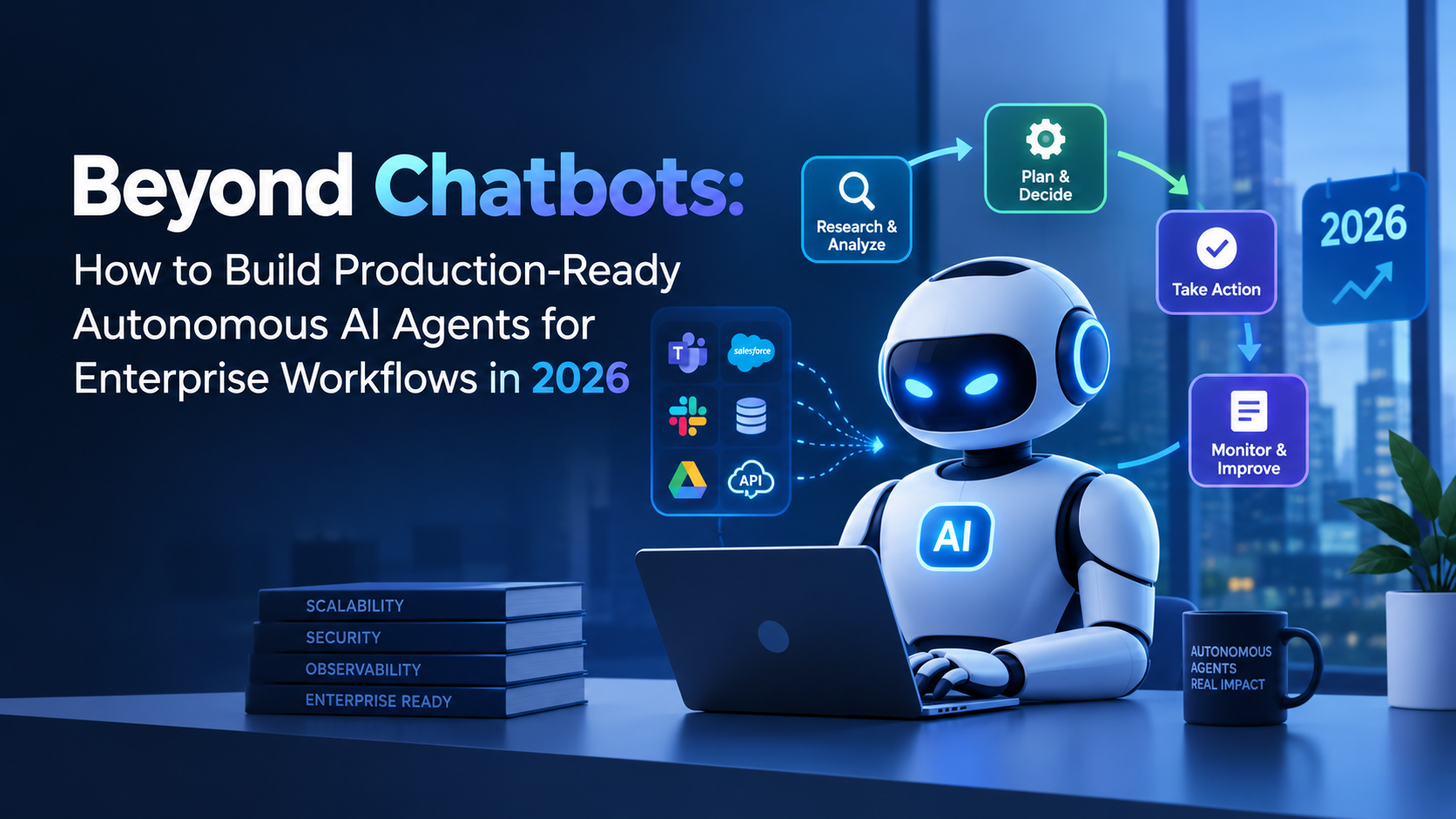
Discover how enterprise engineering teams are moving past static conversational chatbots to deploy resilient, autonomous AI agents capable of executing complex multi-step workflows. Learn the architectural patterns required for scalable production in 2026.
Overview
As we navigate through 2026, the generative AI landscape has shifted decisively. The era of the novelty chat interface is effectively over. Enterprise stakeholders are no longer satisfied with generalized LLMs that simply answer prompts; they demand autonomous AI agents capable of executing multi-step workflows, interacting with legacy systems, and driving measurable business outcomes with minimal human intervention. At CodeCurious, our engineering teams have been at the forefront of this architectural evolution, helping global enterprises transition from experimental prompt-engineering to robust, production-grade autonomous agent systems.
Key Insights
Building autonomous agents for enterprise use requires a fundamentally different engineering mindset than standard web development or basic LLM integration. You are no longer just building deterministic CRUD applications; you are orchestrating probabilistic reasoning engines that must operate within strict enterprise guardrails.
- Deterministic orchestrations must wrap probabilistic LLM reasoning loops to prevent infinite execution traps and hallucinations.
- State management is the single greatest bottleneck in complex agent workflows; externalized graph databases are mandatory for fault tolerance.
- Security and role-based access control (RBAC) must be enforced at the tool-execution layer, not just the chat interface.
- Observability platforms must track semantic drift, token consumption costs, and latent decision paths in real time.
Implementation & Architecture
Designing a production-ready autonomous agent requires a modular architecture composed of four core pillars: the Perception Layer, the Reasoning Engine, the Memory Subsystem, and the Action Network. In a modern enterprise setup, the Perception Layer ingests unstructured data streams, transforming them into structured state vectors. The Reasoning Engine—typically powered by a fine-tuned foundational model—deconstructs high-level user intents into directed acyclic graphs (DAGs) of discrete tasks.
Crucially, the Action Network connects the agent to enterprise APIs via strongly typed tool definitions. Rather than allowing agents to execute arbitrary code, we enforce strict schema validation using tools like Pydantic, ensuring that every payload sent to a legacy ERP or CRM system conforms to rigorous enterprise standards. Furthermore, implementing human-in-the-loop (HITL) checkpoints at critical financial or data-modification thresholds guarantees operational safety without sacrificing speed.
Conclusion & Next Steps
Transitioning to autonomous AI agents is the defining engineering challenge for enterprises in 2026. By shifting focus from simple conversational wrappers to resilient, stateful, and secure agentic architectures, organizations can unlock unprecedented levels of automation and efficiency. Ready to future-proof your tech stack? Contact the expert engineering team at CodeCurious today to accelerate your journey toward true autonomous enterprise workflows.
"Discover how enterprise engineering teams are moving past static conversational chatbots to deploy resilient, autonomous AI agents capable of executing complex multi-step workflows. Learn the architectural patterns required for scalable production in 2026."

Have A Challenging System To Build?
Let's Engineer It Together.
Partner with our senior engineering squad to architect high-concurrency mobile apps, SaaS platforms, and enterprise AI systems.