Beyond Hype: Choosing the Best Tech Stack for Your Startup in 2026
Navigating the rapidly evolving tech landscape can be daunting for startups. Discover the critical considerations and recommended tech stack archetypes for 2026 that will ensure scalability, rapid development, and long-term success for your venture.
Introduction: The Foundation of Startup Success
In the fast-paced world of startups, your tech stack isn't just a collection of tools; it's the very foundation upon which your innovative ideas will either soar or stumble. As we look towards 2026, the technology landscape continues its relentless evolution, introducing new paradigms, refining existing ones, and making the choice more complex than ever. For founders, making an informed decision about their core technologies is paramount to ensuring scalability, speed-to-market, cost-efficiency, and future-proofing their venture.
This guide from CodeCurious will cut through the noise, providing a comprehensive, professional, and forward-looking perspective on the best tech stack considerations for startups aiming for success in 2026 and beyond.
Key Considerations for Your 2026 Tech Stack
Before diving into specific technologies, let's establish the fundamental criteria that should guide your tech stack decision:
- Scalability: Your application needs to gracefully handle growth, from a handful of early adopters to millions of users. Can your chosen stack scale horizontally and vertically without major re-architecture?
- Development Velocity & Time-to-Market: Startups thrive on speed. The stack should enable rapid prototyping, iterative development, and quick deployment of new features to gain a competitive edge.
- Cost-Efficiency: This includes not just hosting and infrastructure but also developer salaries, maintenance, and potential licensing fees. Optimize for both upfront and long-term operational costs.
- Talent Pool & Community Support: The availability of skilled developers familiar with your chosen technologies, alongside robust community support, is crucial for hiring, problem-solving, and ongoing development.
- Security & Compliance: Data breaches can be fatal for startups. Prioritize a stack with strong security features, regular updates, and the ability to meet relevant industry compliance standards.
- Flexibility & Future-Proofing: Technology changes. Choose a stack that is adaptable, allows for integration with future tools, and avoids vendor lock-in where possible.
Core Components of a Modern Startup Tech Stack
A typical web-based startup application comprises several layers. Here’s a breakdown of the key components and leading contenders for 2026:
Frontend Frameworks (User Interface)
The user experience is paramount. These frameworks help build interactive and responsive UIs:
- React.js: Still the undisputed king. Backed by Facebook, its component-based architecture and vast ecosystem make it incredibly versatile for single-page applications (SPAs) and complex UIs. Its virtual DOM ensures efficient updates.
- Vue.js: Known for its gentle learning curve, excellent documentation, and progressive adoption capabilities. Vue is a fantastic choice for startups prioritizing developer happiness and rapid iteration without the steepness of some other frameworks.
- Svelte: Gaining significant traction, Svelte compiles your code into tiny, vanilla JavaScript bundles at build time, leading to exceptionally fast runtime performance and smaller bundle sizes. Ideal for performance-critical applications.
Backend Languages & Frameworks (Server-Side Logic)
This is where your business logic, data processing, and API endpoints reside:
- Node.js (Express/NestJS): Allows full-stack JavaScript development, reducing context switching and enabling shared code. Excellent for real-time applications, microservices, and high-performance APIs due to its asynchronous, event-driven nature. NestJS adds enterprise-grade structure.
- Python (Django/Flask): A powerhouse, especially for startups with AI/ML, data science, or complex analytical components. Django offers a batteries-included approach for rapid development, while Flask provides more flexibility for microservices.
- Go: Developed by Google, Go is an excellent choice for high-performance systems, concurrent applications, and microservices. Its strong typing and efficient compilation make it highly reliable and resource-efficient.
- Ruby on Rails: While not as trendy as it once was, Rails remains a highly productive framework for rapid development of web applications, especially those requiring complex business logic and database interactions. Its convention-over-configuration philosophy accelerates development.
Databases (Data Storage)
Choosing the right database depends on your data structure and access patterns:
- PostgreSQL: The gold standard for relational databases. Robust, feature-rich, highly extensible, and incredibly reliable for complex, structured data. It's often the default choice for many startups due to its versatility.
- MongoDB: A popular NoSQL document database, ideal for flexible, unstructured, or semi-structured data. Excellent for rapid schema evolution and highly scalable. Often paired with Node.js (MERN/MEAN stacks).
- Redis: Primarily an in-memory data store, used for caching, session management, and real-time analytics. Essential for boosting application performance and scalability.
Cloud & Infrastructure
The backbone of modern applications:
- AWS, Google Cloud Platform (GCP), Azure: All offer comprehensive suites of services (compute, storage, serverless, AI/ML). Your choice often comes down to specific feature needs, existing team expertise, and pricing models.
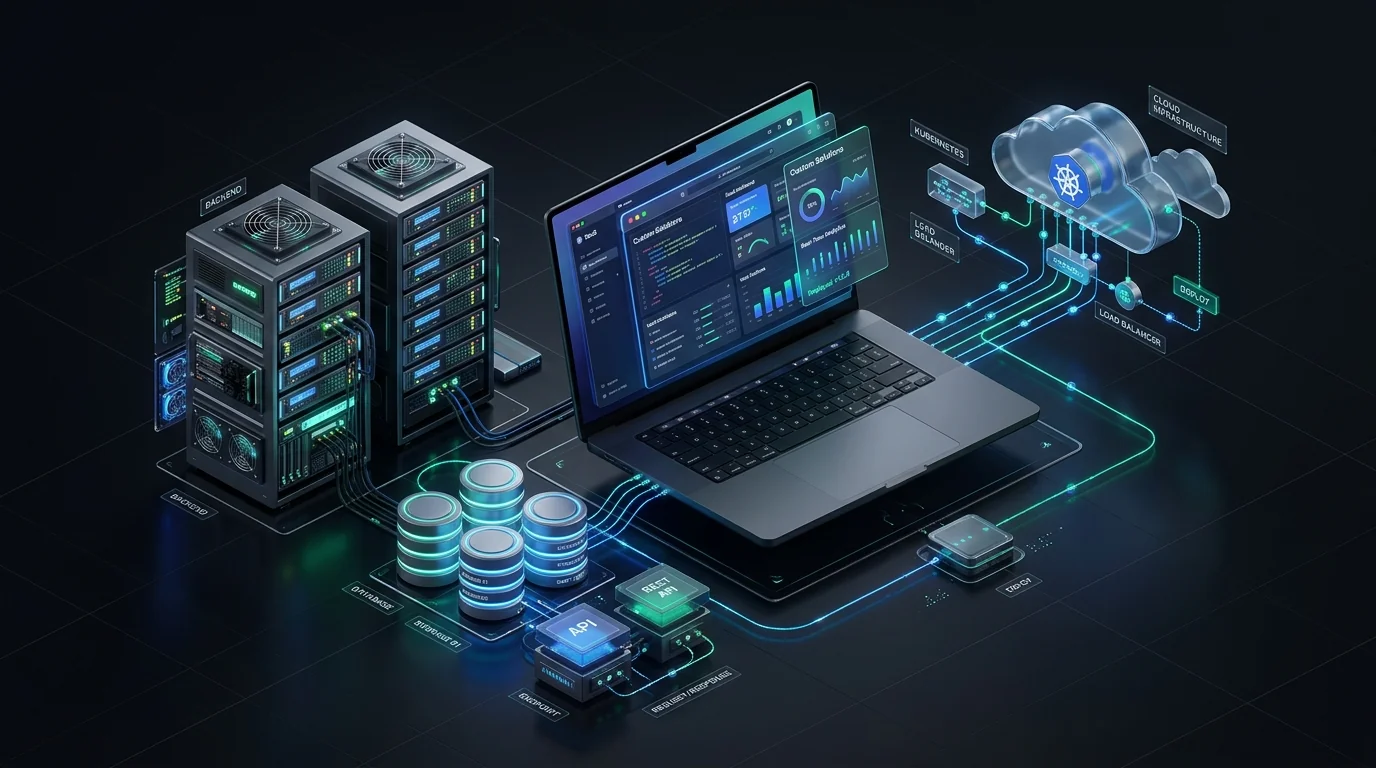
- Docker & Kubernetes: For containerization and orchestration. Docker ensures consistent environments, while Kubernetes automates deployment, scaling, and management of containerized applications, crucial for robust, scalable microservice architectures.
DevOps & CI/CD
- GitHub Actions, GitLab CI, Jenkins: Automate your build, test, and deployment pipelines. Essential for maintaining high code quality and ensuring continuous delivery of features.
Recommended Tech Stack Archetypes for Startups in 2026
While there's no one-size-fits-all, here are some powerful combinations that cater to different startup needs:
- The JavaScript Everywhere Stack (MERN/MEVN/MEAN):
- Frontend: React.js / Vue.js
- Backend: Node.js (Express/NestJS)
- Database: MongoDB (for MERN/MEVN) or PostgreSQL (if relational data is key)
- Cloud: AWS Lambda/EC2, GCP App Engine/Cloud Functions
- Why it works: Single language paradigm reduces cognitive load, large talent pool, excellent for real-time applications and rapid full-stack development.
- The Pythonic AI/ML Powerhouse:
- Frontend: React.js / Vue.js
- Backend: Python (Django/Flask)
- Database: PostgreSQL (often paired with analytical databases like Snowflake/BigQuery for data warehousing)
- Cloud: AWS SageMaker, GCP AI Platform, Azure ML
- Why it works: Unmatched ecosystem for data science, machine learning, and complex data processing. Ideal for AI-first products.
- The Performance-Optimized Go Stack:
- Frontend: React.js / Svelte
- Backend: Go (with frameworks like Gin or Echo)
- Database: PostgreSQL / CockroachDB (for distributed SQL)
- Cloud: Kubernetes on AWS/GCP/Azure
- Why it works: Exceptional performance, concurrency, and reliability. Perfect for infrastructure tools, high-traffic microservices, and systems where resource efficiency is critical.
- The Serverless & Event-Driven Stack:
- Frontend: Static site generator (e.g., Next.js with React) served via CDN
- Backend: AWS Lambda, GCP Cloud Functions, Azure Functions
- Database: DynamoDB, PostgreSQL (RDS), Firestore
- Cloud: Heavily leveraging managed services from AWS/GCP/Azure
- Why it works: Pay-per-execution model dramatically reduces operational costs for fluctuating workloads, provides inherent scalability, and minimizes infrastructure management overhead.
Emerging Trends to Keep an Eye On
To truly build for 2026, consider these burgeoning trends:
- AI-Native Development: Integrating AI tools (e.g., GPT for code generation, Copilot for productivity, AI-driven analytics) directly into the development workflow and product features will be standard.
- Edge Computing: For applications requiring ultra-low latency or processing large volumes of data locally (e.g., IoT, real-time analytics), pushing computation closer to the data source will be crucial.
- Low-Code/No-Code Augmentation: While not replacing custom code, these platforms will increasingly be used by startups for internal tools, rapid prototyping, and non-core functionalities to accelerate development.
- WebAssembly (Wasm) Everywhere: Moving beyond the browser, Wasm is set to enable high-performance code (written in Rust, C++, Go) to run efficiently in server-side environments, IoT devices, and more, offering new avenues for performance optimization.
Conclusion: Build for Today, Plan for Tomorrow
Choosing the best tech stack for your startup in 2026 is a strategic decision that demands careful consideration of your business goals, team expertise, budget, and desired speed. There's no single 'best' stack, but rather a set of optimal choices tailored to your specific context.
Prioritize scalability, development velocity, and a vibrant community. Be open to emerging technologies but ground your core decisions in proven, robust solutions. By thoughtfully selecting your tech stack, you're not just picking tools; you're engineering the future success of your startup. Stay curious, stay agile, and keep building remarkable things!
"Navigating the rapidly evolving tech landscape can be daunting for startups. Discover the critical considerations and recommended tech stack archetypes for 2026 that will ensure scalability, rapid development, and long-term success for your venture."
Have A Challenging System To Build?
Let's Engineer It Together.
Partner with our senior engineering squad to architect high-concurrency mobile apps, SaaS platforms, and enterprise AI systems.