Build vs. Buy: Enterprise Custom CRM Cost Comparison for Scaling Startups in 2026
A comprehensive 2-sentence commercial and architectural guide for scaling startups navigating the 'Build vs. Buy' dilemma for enterprise Custom CRM solutions, focusing on total cost of ownership, technology stacks, and strategic implications for 2026.
1. Executive Summary & Market Economics
For scaling startups in the enterprise ERP ecosystem, the decision to build vs. buy a Custom CRM is not merely a budgetary one; it's a strategic inflection point that dictates long-term agility, competitive differentiation, and operational efficiency. The global CRM market, projected to exceed $150 billion by 2026, underscores its critical role in customer engagement and revenue growth. However, off-the-shelf solutions, while offering rapid deployment, often fall short of meeting the nuanced, complex demands of a rapidly evolving enterprise.
This masterclass provides a technical and commercial deep dive into the total cost of ownership (TCO) for both approaches. We move beyond initial acquisition costs to explore the full lifecycle implications, including development, implementation, integration, maintenance, and future-proofing. For a lean, enterprise-grade custom CRM MVP developed by a skilled team in India, initial build costs in 2026 can range from ₹75 Lakhs to ₹1.5 Crore ($90,000 - $180,000 USD) over 6-12 months. This contrasts with annual SaaS subscriptions that can quickly accumulate, often accompanied by significant customization and integration fees. The strategic advantages of a custom build include unparalleled flexibility, complete ownership of intellectual property, and a system perfectly aligned with unique business processes. Disadvantages typically revolve around higher upfront investment and longer time-to-market. Key decision factors for scaling startups include budget constraints, time sensitivity, the uniqueness of operational requirements, and ambitious future growth projections.
2. Key Application Types & Capabilities
Understanding the spectrum of CRM solutions is fundamental to an informed decision. These typically fall into three categories:
- Off-the-shelf (SaaS) CRMs: Cloud-based, subscription models (e.g., Salesforce, HubSpot, Zoho CRM). They offer quick deployment, standardized features, and vendor-managed infrastructure. Ideal for generic needs but often rigid for complex, unique workflows.
- Highly Configurable (PaaS/Hybrid) CRMs: Solutions built on platforms allowing extensive customization, workflow automation, and third-party integrations (e.g., Microsoft Dynamics 365, Salesforce Platform). They offer more flexibility than pure SaaS but still operate within a vendor's ecosystem, potentially leading to vendor lock-in.
- Fully Custom CRMs: Developed from the ground up to meet specific business requirements. These provide ultimate flexibility, scalability, and integration capabilities, making them ideal for enterprises with distinct operational models, high data volume, or complex regulatory compliance needs.
Core CRM capabilities include Sales Force Automation (SFA) for lead and opportunity management, Marketing Automation for campaign execution and lead nurturing, Customer Service & Support for ticketing and case management, and robust Analytics & Reporting for performance insights. For scaling startups, advanced capabilities are increasingly crucial: AI/ML-driven insights for predictive analytics and lead scoring, omnichannel communication for consistent customer interactions, and seamless ERP integration for a unified view of customer and operational data. Matching these capabilities to specific growth phases and industry needs (e.g., long B2B enterprise sales cycles) is paramount. Evaluating flexibility and extensibility—the system's ability to adapt to evolving business processes and market demands—is a non-negotiable for long-term strategic value.
3. Feature-by-Feature Architecture & Cost Breakdown
A granular understanding of cost structures is vital for accurate TCO comparison. Here, we dissect the financial implications of both 'Buy' and 'Build' approaches.
Cost Analysis for 'Buy' (SaaS/PaaS) Solutions:
- License Fees: Per-user, per-module, or tiered subscriptions. For enterprise-grade, this can range from ₹80,000 - ₹2.5 Lakh ($960 - $3,000) per user per year.
- Implementation Partners: Often required for complex deployments, costing 50% to 200% of the annual license fees in the first year.
- Customization Costs: Configuration, workflow automation, custom fields. Can be substantial if requiring developer-level work.
- Integration Fees: Connecting with existing ERP, marketing automation, or communication platforms. Many SaaS vendors charge per API call or per integration connector.
- Data Migration: Transferring historical customer data, often a complex and costly endeavor.
- Training & Support: Initial onboarding, ongoing user training, and premium support tiers.
- Hidden Costs: Vendor lock-in, feature bloat, performance limitations, and potential for unanticipated usage overage charges.
Cost Analysis for 'Build' (Custom Development):
- Development Team Salaries: The largest component. A typical team includes Frontend Developers, Backend Developers, QA Engineers, DevOps Specialists, and a Project Manager. In India (2026), a senior developer can command ₹4 Lakh - ₹6.5 Lakh ($4,800 - $7,800) per month. A full team of 5-7 members for 12-18 months represents a significant investment.
- Infrastructure Costs: Cloud hosting (AWS, Azure, GCP), databases, CDN, monitoring tools. These are ongoing operational expenses, but scalable as you grow.
- Third-Party API Integrations: Costs for external services (e.g., SMS gateways, payment processors, specific data enrichment APIs).
- Security Audits & Compliance: Essential for enterprise data. Regular audits and certifications (e.g., ISO 27001, GDPR) add to costs.
- Ongoing Maintenance & Support: Bug fixes, security patches, performance optimization, and server management. Typically 15-30% of the initial development cost annually.
- Future Feature Development: Continuous iteration and addition of new capabilities are inherent to custom solutions.
- Architectural Considerations: Decisions like Microservices vs. Monolithic architecture, API-first design, and robust data model design significantly impact development complexity and future scalability.
- Hidden Costs: Technical debt if not managed, opportunity cost of internal resources, and the overhead of managing a development team.
Cost Estimation Matrix: Build vs. Buy for Scaling Startups (2026)
| App Tier | Scope | Cost (INR / USD) | Timeline |
|---|---|---|---|
| SaaS (Basic/Growth) | Core sales, contact/account management, basic reporting, limited integrations. | ₹25K - ₹75K / user/year + ₹5L - ₹20L setup ($300 - $900 / user/year + $6K - $24K setup) |
2-6 weeks |
| SaaS (Enterprise) | Advanced SFA, marketing, service, complex workflows, multiple integrations. | ₹80K - ₹2.5L / user/year + ₹20L - ₹1Cr implementation ($960 - $3K / user/year + $24K - $120K implementation) |
3-9 months |
| Custom (MVP) | Tailored core SFA, contact/account management, custom reporting, 1-2 key integrations. | ₹80L - ₹1.8Cr for build + 15-25% annual maintenance ($96K - $216K for build + 15-25% annual maintenance) |
6-12 months |
| Custom (Enterprise) | Comprehensive suite, AI/ML, omnichannel, deep ERP, highly scalable, unique business logic. | ₹2.5Cr - ₹8Cr+ for build + 20-30% annual maintenance ($300K - $960K+ for build + 20-30% annual maintenance) |
12-24+ months |
Module-by-Module Cost & Architecture Insights (Custom Build)
Robust JWT/OAuth2 authentication, role-based access control (RBAC), multi-factor authentication (MFA). Critical for enterprise security and compliance.
Lead management, opportunity tracking, account/contact management, activity logging, custom sales pipelines. Forms the backbone of any CRM.
Case creation, assignment, routing, knowledge base integration, SLA management, customer communication history. Essential for post-sales support.
Customizable dashboards, real-time data visualization, performance metrics (sales, marketing, service), historical trend analysis. Data-driven decision making.
API layer for seamless, bidirectional data flow with existing ERP systems (e.g., SAP, Oracle, Microsoft Dynamics). Ensures data consistency and eliminates silos.
Leverages machine learning models to score leads based on historical data, engagement patterns, and demographic information, improving sales efficiency.
4. Recommended Technology Stack in 2026
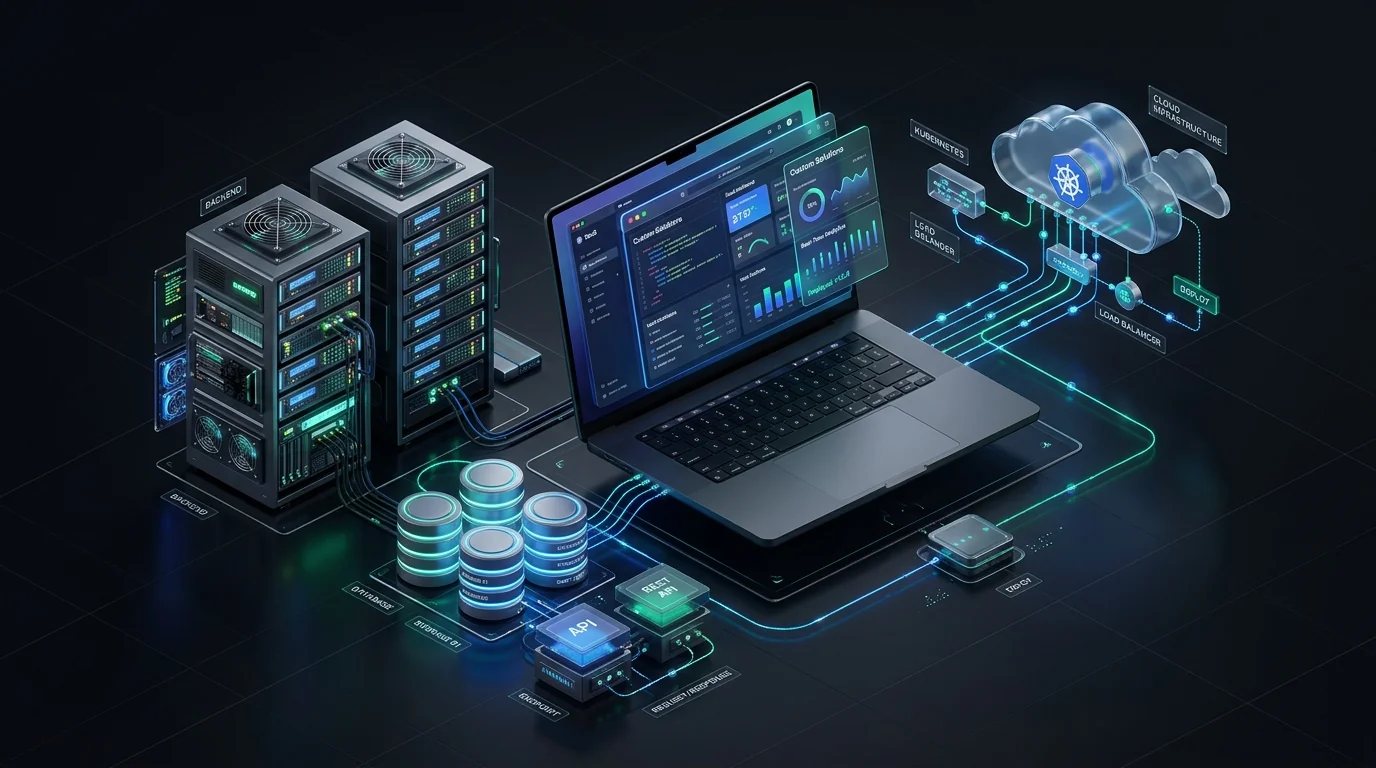
For a custom enterprise-grade CRM in 2026, a modern, scalable, and maintainable technology stack is paramount. The following recommendations balance performance, developer productivity, and long-term viability:
- Modern Backend Frameworks:
- Python: Django (robust, batteries-included) or Flask (microframework for specific services). Excellent for rapid development and AI/ML integration.
- Node.js: NestJS (structured, enterprise-grade) or Express (minimalist). Ideal for high-performance, real-time applications and microservices.
- Go: Gin or Echo. Known for superior performance, concurrency, and smaller memory footprint, suitable for high-traffic services.
- Java: Spring Boot. Industry standard for large-scale enterprise applications, offering stability and a vast ecosystem.
- Frontend Technologies:
- React: Dominant for building complex, highly interactive user interfaces with a strong component-based architecture.
- Vue.js: Progressive framework, easier learning curve, excellent for single-page applications and incremental adoption.
- Angular: Comprehensive framework for large-scale enterprise applications, offering opinionated structure and powerful tools.
- Database Solutions:
- PostgreSQL: Robust, open-source relational database. Ideal for structured CRM data, ensuring data integrity and complex querying.
- MongoDB/Cassandra: NoSQL options for flexible schema requirements, high-volume unstructured data (e.g., customer interactions, logs), and horizontal scalability.
- Redis: In-memory data store for caching, session management, and real-time analytics, significantly improving application responsiveness.
- Cloud Infrastructure:
- AWS, Azure, GCP: Leading providers offering comprehensive suites of services. Emphasis on serverless computing (AWS Lambda, Azure Functions, Google Cloud Functions) for cost efficiency and scalability.
- Managed Services: Utilize managed databases (AWS RDS, Azure SQL Database, Google Cloud SQL), managed Kubernetes (EKS, AKS, GKE), and other platform services to reduce operational overhead.
- AI/ML Integration:
- TensorFlow, PyTorch: Open-source libraries for building custom AI/ML models for predictive analytics, lead scoring, sentiment analysis, and automation.
- Cloud-native AI Services: Leverage pre-trained models and APIs from cloud providers (e.g., AWS SageMaker, Azure AI, Google AI Platform) for faster deployment of common AI functionalities.
- Containerization & Orchestration:
- Docker: For packaging applications and their dependencies into portable containers, ensuring consistent environments.
- Kubernetes: For automating deployment, scaling, and management of containerized applications, critical for microservices architectures and high availability.
- DevOps Practices:
- CI/CD Pipelines: Implement Continuous Integration/Continuous Deployment using tools like GitLab CI, GitHub Actions, or Jenkins for automated testing, building, and deployment, enabling rapid iteration and reliability.
5. Frequently Asked Questions (FAQ)
Q: When is building a custom CRM truly more cost-effective than buying for a scaling startup?
A: Building a custom CRM becomes more cost-effective when your startup has highly unique business processes, requires deep, bespoke integrations with existing proprietary ERP or legacy systems, or when the long-term TCO of a 'bought' solution (including extensive customization, add-ons, and scaling user licenses) surpasses the cost of development and maintenance. This tipping point typically occurs when a startup anticipates significant growth, has specific competitive differentiators tied to its customer interactions, and finds that off-the-shelf solutions require over 30-40% customization to meet core requirements. The initial higher investment in a custom build can yield substantial ROI over 3-5 years by avoiding recurring license fees and achieving perfect process alignment.
Q: What are the biggest hidden costs associated with both 'Build' and 'Buy' CRM approaches?
A: For 'Buy' solutions, hidden costs include vendor lock-in (making migration difficult and expensive), unexpected increases in license fees or usage charges, the cost of integrating with other systems (which can be substantial and often requires third-party consultants), and the opportunity cost of not having a system perfectly tailored to your unique workflows. For 'Build' solutions, hidden costs can involve technical debt (if development is rushed or poorly managed), the ongoing cost of talent acquisition and retention for the development team, the overhead of managing infrastructure and security compliance, and the potential for project delays leading to missed market opportunities. Both approaches also carry the hidden cost of change management and user adoption if not properly planned.
Q: How can a startup ensure future-proofing and scalability for their chosen CRM solution?
A: For 'Buy' solutions, ensure the chosen vendor has a robust API ecosystem, a clear product roadmap, and a history of continuous innovation. Look for solutions built on flexible platforms (PaaS) that allow for extensive configuration and custom development without breaking core functionalities. For 'Build' solutions, future-proofing and scalability are inherent in the architectural design. Employ a microservices architecture, API-first design principles, and leverage cloud-native services (serverless, managed databases, Kubernetes). Use modern, performant programming languages and frameworks. Implement robust DevOps practices with CI/CD pipelines to enable rapid, reliable deployment of new features and updates. Prioritize modularity, clean code, and comprehensive documentation to facilitate future enhancements and team transitions. Regularly review and optimize the technology stack to adapt to evolving industry standards.
"A comprehensive 2-sentence commercial and architectural guide for scaling startups navigating the 'Build vs. Buy' dilemma for enterprise Custom CRM solutions, focusing on total cost of ownership, technology stacks, and strategic implications for 2026."
Have A Challenging System To Build?
Let's Engineer It Together.
Partner with our senior engineering squad to architect high-concurrency mobile apps, SaaS platforms, and enterprise AI systems.