
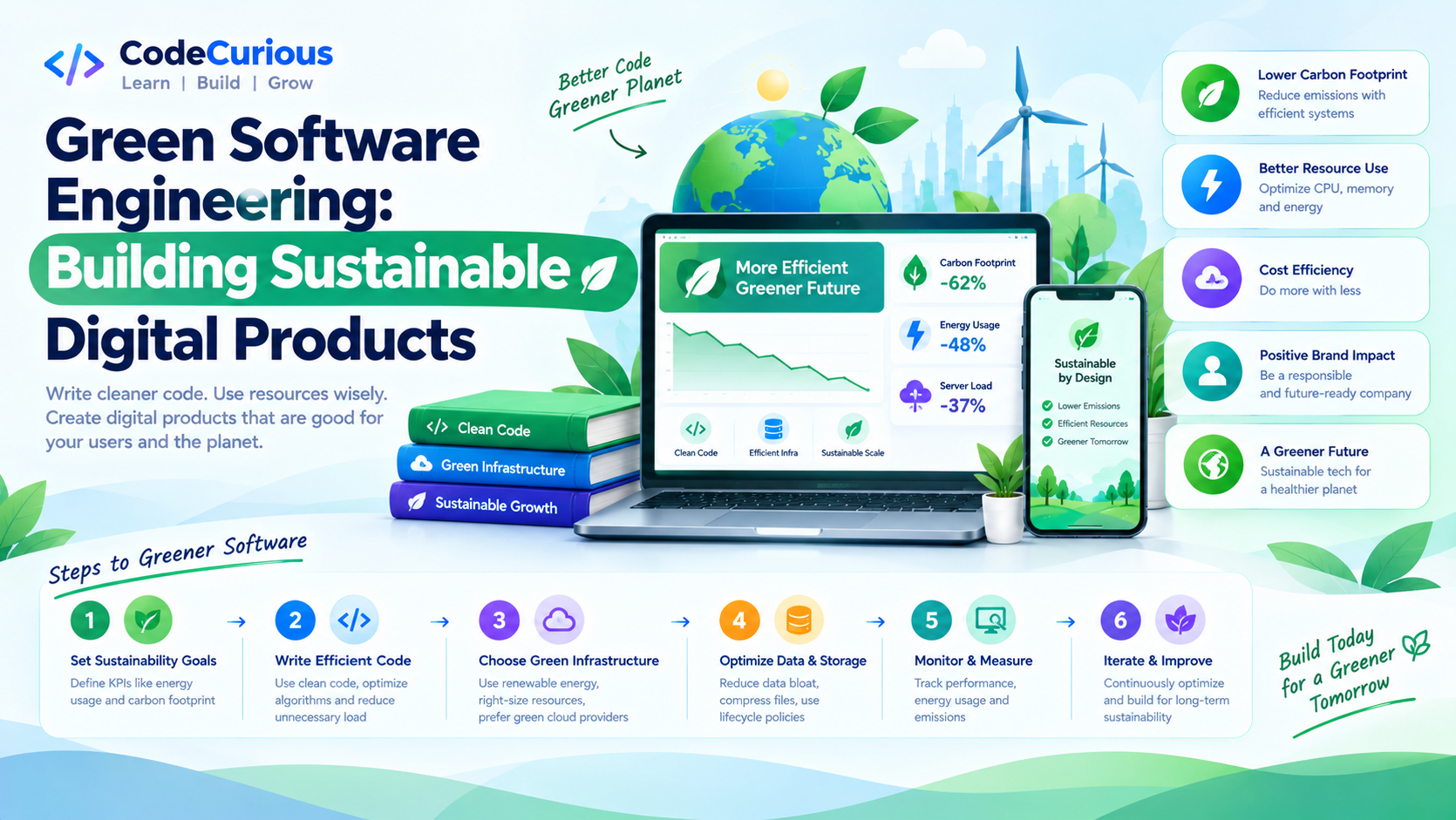
Green Software Engineering: Building Sustainable Digital Products
Discover how Green Software Engineering builds eco-friendly digital products, optimizes energy efficiency, and reduces cloud costs. Learn CodeCurious Technologies' approach to sustainable innovation.
1. The Imperative of Green Software Engineering: Why Sustainability Matters Now
In an era defined by rapid digital transformation, the environmental footprint of our technology can no longer be ignored. From data centers consuming vast amounts of energy to inefficient code bloating cloud resources, the digital world contributes significantly to global carbon emissions. This is where Green Software Engineering emerges, not just as a trend, but as a critical paradigm shift for building truly sustainable digital products.
At CodeCurious Technologies Pvt. Ltd., headquartered in the vibrant Mohali / Chandigarh Tricity, Punjab, India, we recognize that engineering excellence must go hand-in-hand with environmental responsibility. Our mission is to empower ambitious startups and global enterprises across India, the US, UK, Europe, and Dubai / UAE to build high-performance, scalable, and inherently eco-friendly software solutions. We believe that sustainable software isn't just good for the planet; it's smart business, driving down operational costs, enhancing brand reputation, and future-proofing your digital infrastructure.
This comprehensive guide will delve into the core principles, architectural considerations, and practical methodologies of Green Software Engineering. We'll explore how to reduce your digital carbon footprint, optimize energy consumption, and leverage cutting-edge technologies to create more efficient and responsible applications. Whether you are a startup scaling across Delhi-NCR or Mohali, an enterprise navigating digital transformation in Dubai, or a US-based founder looking for a dedicated software development squad in India, understanding these principles is paramount for achieving both ecological and economic sustainability.
2. Core Principles of Sustainable Software Development
Green Software Engineering is a multidisciplinary approach that seeks to minimize the environmental impact of software throughout its entire lifecycle. It's about more than just switching off monitors; it involves conscious design, development, deployment, and operational choices.
2.1. Energy Efficiency & Resource Optimization
At its heart, green software aims for maximum output with minimum energy input. This means writing efficient code that executes quickly, consumes less CPU cycles, and requires fewer memory resources. It also extends to optimizing cloud infrastructure, ensuring that resources are provisioned intelligently and scaled dynamically to match demand, preventing wasteful over-provisioning.
2.2. Carbon-Aware Development Practices
Understanding the carbon intensity of different cloud regions and services is crucial. Developers can make informed choices about where to deploy applications, favoring regions powered by renewable energy. This principle also encourages minimizing data transfer, which has a significant energy cost, and optimizing data storage solutions.
2.3. Hardware Efficiency & Circularity
While often outside the direct control of software engineers, green software practices indirectly influence hardware lifespan. Efficient software can run effectively on older or less powerful hardware, extending its utility and reducing the demand for new manufacturing. This aligns with the principles of a circular economy, reducing electronic waste.
2.4. Data Efficiency & Storage Optimization
Data has a weight – a digital carbon footprint. Storing vast amounts of redundant, unused, or inefficiently structured data consumes energy. Green software advocates for data minimization, smart compression techniques, efficient database indexing (a CodeCurious specialty with PostgreSQL), and intelligent data lifecycle management to reduce storage and processing demands.
3. Architectural Blueprint for Eco-Friendly Digital Products
Building sustainable digital products requires a thoughtful architectural approach. CodeCurious Technologies leverages battle-tested strategies to design systems that are inherently energy-efficient and scalable.
3.1. Cloud-Native vs. On-Premise: The Green Calculus
While on-premise solutions offer direct control, cloud-native architectures (leveraging AWS, GCP, or Azure) often provide superior energy efficiency due to economies of scale, shared infrastructure, and advanced virtualization. However, the 'greenness' depends on the cloud provider's commitment to renewable energy and the specific services chosen. We analyze your unique needs to select the most carbon-efficient cloud strategy, ensuring compliance with GCC enterprise standards for clients in Dubai / UAE or robust IP protection for US/UK/Europe.
3.2. Language & Framework Selection for Low Carbon Footprint
The choice of programming language and framework significantly impacts performance and energy consumption. At CodeCurious, we prioritize technologies that offer high performance and resource efficiency:
- Next.js 15 & React: For highly optimized, server-side rendered (SSR) and static-generated (SSG) web applications, minimizing client-side processing and improving load times.
- Flutter: For cross-platform mobile apps, delivering native-like performance from a single codebase, reducing development effort and resource usage across multiple platforms.
- Node.js: Its non-blocking I/O model is excellent for building efficient, high-concurrency applications with lower resource overhead.
- Python AI: While Python can be resource-intensive, our experts optimize AI/ML workflows, leveraging efficient libraries and cloud-native AI services to minimize compute time and energy.
3.3. Data Management & Database Optimization (PostgreSQL)
Efficient data storage and retrieval are paramount. We architect robust data solutions using PostgreSQL, optimizing queries, indexing strategies, and database schemas to reduce I/O operations and CPU cycles. This directly translates to lower energy consumption and faster application response times.
3.4. DevOps & CI/CD for Sustainable Operations
Our DevOps practices integrate green principles from the outset. Automated CI/CD pipelines ensure efficient deployment, reduce manual errors, and enable rapid iteration. We implement intelligent auto-scaling, serverless functions, and containerization (e.g., Docker, Kubernetes) to ensure that resources are only consumed when needed, significantly reducing idle energy waste.
CriteriaTraditional Software ArchitectureGreen Software Architecture (CodeCurious Approach)Cloud Resource UtilizationOver-provisioned, static servers, high idle waste.Dynamic scaling, serverless functions, containerization, optimized resource allocation.Code EfficiencyBloated code, inefficient algorithms, high CPU/memory footprint.Optimized algorithms, lean codebases (Next.js, Node.js), lazy loading, caching.Data ManagementRedundant data, unoptimized queries, high storage I/O.Data minimization, intelligent indexing (PostgreSQL), efficient compression, data lifecycle management.Deployment FrequencyInfrequent, manual deployments, higher risk of errors.Automated CI/CD (DevOps), frequent, small deployments, reduced energy for testing/rework.Energy Source AwarenessIgnored or not considered in deployment decisions.Deployment to renewable-powered cloud regions, carbon-aware routing.Development Cost EfficiencyHigh operational costs from inefficient infrastructure.Reduced cloud bills, optimized resource usage, long-term ROI.
4. Step-by-Step Implementation: Building a Green Software Ecosystem with CodeCurious
At CodeCurious Technologies, our approach to Green Software Engineering is systematic, transparent, and results-driven. We guarantee 100% source code and IP ownership, bi-weekly live sprint demos, and zero hidden fees, ensuring you're always in control of your sustainable journey.
- Discovery & Carbon Footprint Assessment: We begin with a deep dive into your existing infrastructure (if any) and business requirements. Our architects analyze current energy consumption patterns, identify high-impact areas, and establish baseline metrics for your digital carbon footprint. For new projects, we define green KPIs from day one.
- Sustainable Architecture Design: Leveraging our expertise in Next.js 15, React, Flutter, Node.js, Python AI, and PostgreSQL, we design a cloud-native, energy-efficient architecture. This includes selecting optimal cloud regions (AWS/GCP), designing efficient database schemas, and planning for serverless or containerized deployment.
- Lean & Optimized Development: Our dedicated senior engineers focus on writing clean, efficient, and performant code. We implement best practices like lazy loading, caching, efficient data structures, and optimized algorithms to minimize resource consumption at every layer.
- DevOps for Green Operations: We establish robust CI/CD pipelines that automate deployments, enforce code quality, and integrate carbon monitoring tools. Our DevOps engineers configure intelligent auto-scaling, resource provisioning, and infrastructure-as-code to ensure your application runs on precisely the resources it needs, minimizing waste.
- Continuous Monitoring & Optimization: Post-launch, we implement continuous monitoring of your application's energy consumption and carbon footprint. Utilizing advanced analytics, we identify further optimization opportunities, fine-tune configurations, and ensure your application remains eco-friendly as it scales.
- Knowledge Transfer & Future-Proofing: We ensure your team is fully equipped with the knowledge and tools to maintain and evolve your green software solution. Our transparent process and comprehensive documentation empower you for long-term sustainability.
5. Real-World Impact: CodeCurious's Green Software Case Study
A recent collaboration with a rapidly scaling e-commerce startup in the Delhi-NCR region perfectly illustrates CodeCurious Technologies' commitment to sustainable engineering. The client faced escalating cloud bills and slow page load times, impacting user experience and profitability. Their legacy monolithic architecture on a traditional cloud setup was inefficient and resource-heavy.
The Challenge: Reduce cloud infrastructure costs by 40% and improve application response times by 50% while supporting a 3x increase in user traffic, all with a focus on lowering their digital carbon footprint.
CodeCurious Solution: Our team, comprising senior engineers specializing in Next.js 15, Node.js, and PostgreSQL, re-architected their platform. We migrated critical components to a serverless architecture on AWS Lambda and API Gateway, optimized their PostgreSQL database with advanced indexing and query tuning, and implemented a highly efficient Next.js 15 frontend with extensive caching and static site generation for product pages.
Results Achieved:
- 55% Reduction in Cloud Costs: By moving to serverless functions and optimizing database operations, we significantly reduced their monthly AWS expenditure.
- 70% Improvement in Page Load Times: The Next.js 15 frontend, combined with optimized backend APIs, delivered sub-50ms latency for critical user journeys, dramatically enhancing user experience.
- 4x Throughput Capacity: The new architecture effortlessly handled peak traffic surges, supporting a fourfold increase in concurrent users without performance degradation.
- Estimated 40% Reduction in Carbon Footprint: By drastically cutting down on idle server time and optimizing resource utilization, the overall energy consumption associated with their digital product was substantially lowered.
This case study exemplifies how CodeCurious delivers not just high-performance, scalable solutions, but also integrates eco-friendly tech principles to achieve tangible business and environmental benefits. Our dedicated senior engineers ensured these results were delivered with bi-weekly live sprint demos and absolute transparency.
6. Measuring & Monitoring Your Digital Carbon Footprint
What gets measured, gets managed. To truly embrace Green IT, organizations must actively measure and monitor their digital carbon footprint. This involves understanding the energy consumption of their software and the associated emissions.
6.1. Tools and Metrics for Green IT
Various tools and methodologies exist to assess software's environmental impact, from cloud provider dashboards that show regional energy mix to specialized carbon accounting APIs. Key metrics include: Energy Consumption (kWh), Carbon Emissions (kgCO2e), Power Usage Effectiveness (PUE) of data centers, and Carbon Intensity of cloud regions. CodeCurious integrates these metrics into our DevOps monitoring, providing clients with clear visibility into their environmental impact.
6.2. The Business Case: ROI of Sustainable Software
Beyond environmental benefits, Green Software Engineering offers a compelling return on investment. Reduced cloud costs, improved application performance, enhanced developer productivity, and a stronger brand image are direct outcomes. Companies committed to sustainability attract top talent and appeal to an increasingly eco-conscious customer base, driving both revenue and reputation.
7. Frequently Asked Questions (FAQs) About Green Software Engineering
Q1: What exactly is Green Software Engineering and why is it crucial for enterprises?
Green Software Engineering is the practice of designing, developing, and operating software to minimize its environmental impact, particularly its energy consumption and carbon emissions. For enterprises, it's crucial because it reduces cloud costs, improves application performance and scalability, enhances brand reputation, ensures compliance with emerging environmental regulations, and attracts environmentally conscious talent and customers. It's a strategic move towards both ecological and economic sustainability.
Q2: How does CodeCurious Technologies help reduce my application's carbon footprint and cloud costs?
CodeCurious Technologies employs a multi-faceted approach. We optimize your architecture with serverless and containerized solutions (AWS/GCP), select energy-efficient programming languages and frameworks (Next.js 15, Node.js, Flutter), and implement lean, performant code. Our PostgreSQL experts fine-tune databases for minimal resource usage, and our DevOps practices ensure intelligent resource scaling. This holistic strategy directly translates to reduced energy consumption and lower cloud bills, often by 40-60% compared to traditional approaches.
Q3: Can adopting green software practices truly improve performance and scalability?
Absolutely. The principles of green software engineering—such as optimizing code, minimizing data transfer, efficient resource allocation, and smart database management—are inherently aligned with building high-performance and scalable applications. Less resource consumption means faster execution, lower latency, and the ability to handle more users with the same or fewer resources. Our case studies frequently show significant improvements in throughput and response times alongside cost and carbon reductions.
Q4: What specific technologies and methodologies does CodeCurious leverage for sustainable development?
CodeCurious utilizes a cutting-edge tech stack including Next.js 15, React, Flutter, Node.js, Python AI, and PostgreSQL. We combine these with modern DevOps practices, cloud-native architectures (AWS/GCP), and Agentic AI workflows to optimize resource usage. Our methodologies prioritize clean code, efficient algorithms, data minimization, and continuous performance monitoring to ensure every solution is built for maximum efficiency and minimal environmental impact.
Q5: How can businesses in Dubai, the US, or Europe get started with CodeCurious for green software initiatives?
Getting started is simple, no matter your location. Businesses in Dubai / UAE can benefit from our deep understanding of GCC enterprise standards, UAE PASS integration, and VAT compliance. US, UK, and European clients leverage our overlapping timezones, robust IP protection, and access to top 1% engineering talent in India at 40-60% development cost efficiency. Simply book an architectural discovery call on our website to discuss your specific needs. We offer remote dedicated developer squads ready to transform your digital products into sustainable powerhouses.
8. Conclusion: Partnering for a Sustainable Digital Future
The journey towards a sustainable digital future is not merely an option; it's an imperative. Green Software Engineering offers a powerful pathway to achieve this, transforming environmental responsibility into a competitive advantage. By embracing eco-friendly tech and optimizing for energy efficiency, businesses can significantly reduce their operational costs, enhance performance, and contribute positively to global sustainability goals.
At CodeCurious Technologies, we are more than just a software engineering firm; we are your strategic partner in building a greener, more efficient digital world. Our commitment to 100% source code and IP ownership, bi-weekly live sprint demos, zero hidden fees, and dedicated senior engineers ensures transparency and trust. Whether you're looking to build a new sustainable digital product from scratch or optimize your existing infrastructure for reduced carbon footprint, our battle-tested expertise in Next.js 15, React, Flutter, Node.js, Python AI, PostgreSQL, AWS/GCP, and DevOps is at your service. From Mohali / Chandigarh Tricity to Dubai, London, and New York, we are ready to engineer your next success story.
Ready to build sustainable, high-performance digital products? Book an architectural discovery call with CodeCurious Technologies today and explore how we can engineer your future. You can also explore our dedicated developer squads or use our interactive Build vs. Buy Calculator to understand your options.
"Discover how Green Software Engineering builds eco-friendly digital products, optimizes energy efficiency, and reduces cloud costs. Learn CodeCurious Technologies' approach to sustainable innovation."

Have A Challenging System To Build?
Let's Engineer It Together.
Partner with our senior engineering squad to architect high-concurrency mobile apps, SaaS platforms, and enterprise AI systems.