
Multi-Tenant SaaS Architecture: Row-Level Security vs. Schema-per-Tenant in PostgreSQL
Architecting a scalable multi-tenant SaaS application requires choosing the right PostgreSQL isolation strategy. Compare Row-Level Security (RLS) against Schema-per-Tenant to optimize your application's security and performance.
Overview
Choosing the right data isolation strategy is one of the most critical architectural decisions you will make when building a multi-tenant SaaS application on PostgreSQL. Get it wrong, and you face either crippling database migration overhead as you scale or catastrophic data leaks between enterprise clients. At CodeCurious, we frequently help engineering teams evaluate their options between two dominant paradigms: Row-Level Security (RLS) and Schema-per-Tenant.
Key Insights
Both architectural patterns offer distinct trade-offs regarding security, migration complexity, resource utilization, and cost:
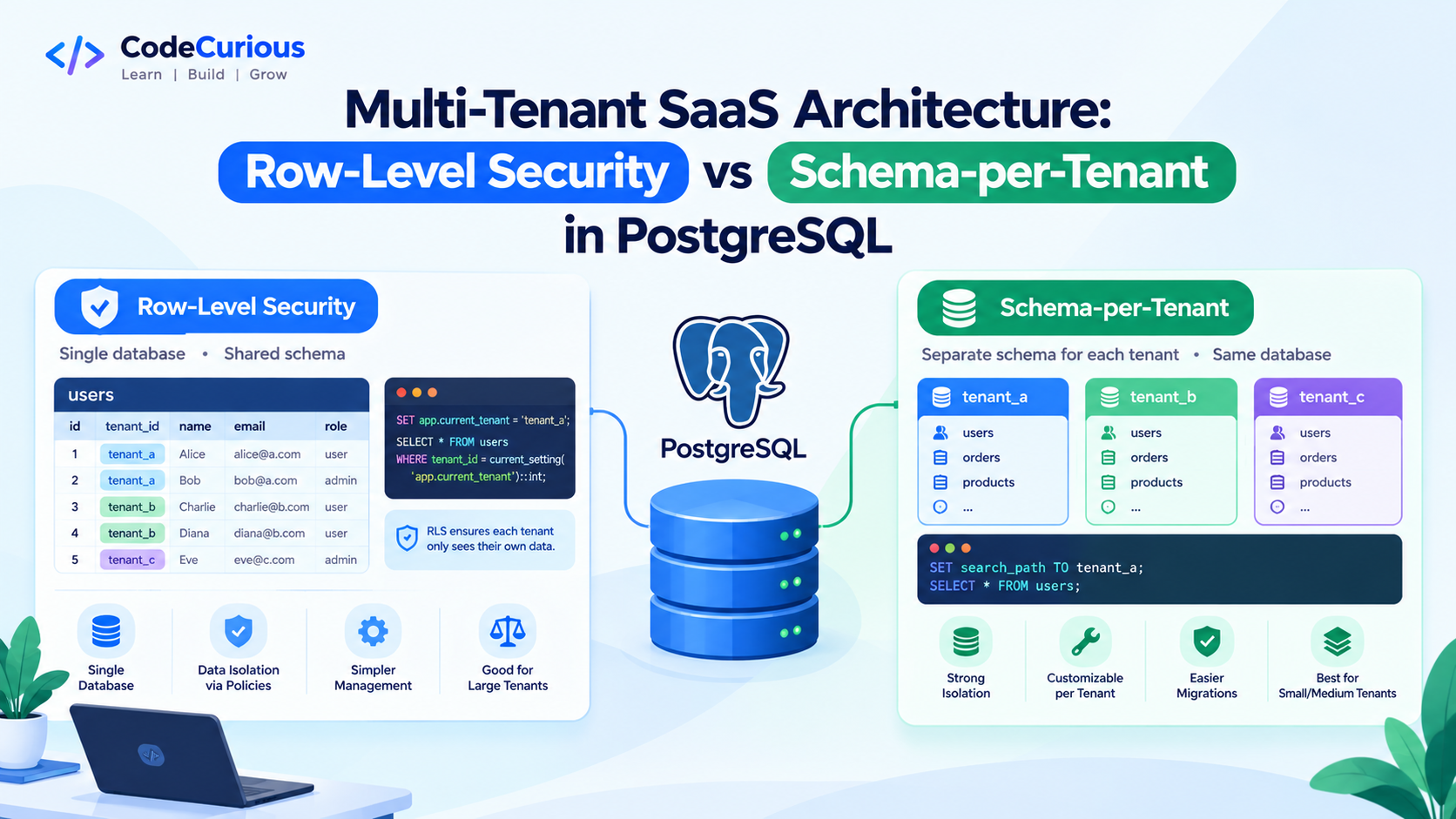
- Row-Level Security (RLS) shares tables across all tenants, utilizing a tenant identifier column and PostgreSQL policies to restrict data access dynamically.
- Schema-per-Tenant isolates each customer inside their own dedicated PostgreSQL schema, providing robust physical separation while utilizing a single database instance.
- RLS maximizes resource efficiency and simplifies database migrations, but introduces complexity in caching, query tuning, and security context handling.
- Schema-per-Tenant drastically limits 'noisy neighbor' risks and simplifies compliance auditing, but creates severe schema migration friction as your tenant count scales into the thousands.
Implementation & Architecture
Let's examine how these two patterns are implemented in practice. With PostgreSQL Row-Level Security, every table includes a tenant_id column. We enforce isolation at the database engine level using policies tied to session variables.
-- Enable RLS on the tenants table
ALTER TABLE todos ENABLE ROW LEVEL SECURITY;

-- Create isolation policy
CREATE POLICY tenant_isolation_policy ON todos
    USING (tenant_id = current_setting('app.current_tenant_id')::uuid);

-- Set context in your application before querying
SET LOCAL app.current_tenant_id = 'a0eebc99-9c0b-4ef8-bb6d-6bb9bd380a11';
SELECT * FROM todos;
Conversely, the Schema-per-Tenant pattern isolates data by dynamically routing queries to schema-namespaced tables based on the authenticated request context.
-- Create a dedicated schema for a tenant
CREATE SCHEMA tenant_acme;

-- Create tables within that tenant's schema
CREATE TABLE tenant_acme.todos (
    id UUID PRIMARY KEY,
    title TEXT,
    completed BOOLEAN
);

-- Route application traffic by altering the search path dynamically
SET search_path TO tenant_acme, public;
SELECT * FROM todos;
Conclusion & Next Steps
The choice between Row-Level Security and Schema-per-Tenant ultimately depends on your SaaS business model, compliance requirements, and scale. If you are bootstrapping a high-volume B2B SaaS with hundreds of thousands of light tenants, PostgreSQL RLS provides the operational simplicity and cost-effectiveness you need. If you cater to elite enterprise clients requiring strict data compartmentalization and custom database backups, Schema-per-Tenant is the gold standard. Need help designing a resilient, high-performance database architecture for your SaaS platform? Reach out to the engineering experts at CodeCurious today to accelerate your roadmap.
"Architecting a scalable multi-tenant SaaS application requires choosing the right PostgreSQL isolation strategy. Compare Row-Level Security (RLS) against Schema-per-Tenant to optimize your application's security and performance."

Have A Challenging System To Build?
Let's Engineer It Together.
Partner with our senior engineering squad to architect high-concurrency mobile apps, SaaS platforms, and enterprise AI systems.