
Securing Your AI: Mitigating Emerging Threats in 2026 | CodeCurious
Explore critical AI security threats for 2026 and advanced mitigation strategies. Learn how CodeCurious Technologies engineers robust, ethical, and compliant AI systems for global enterprises.
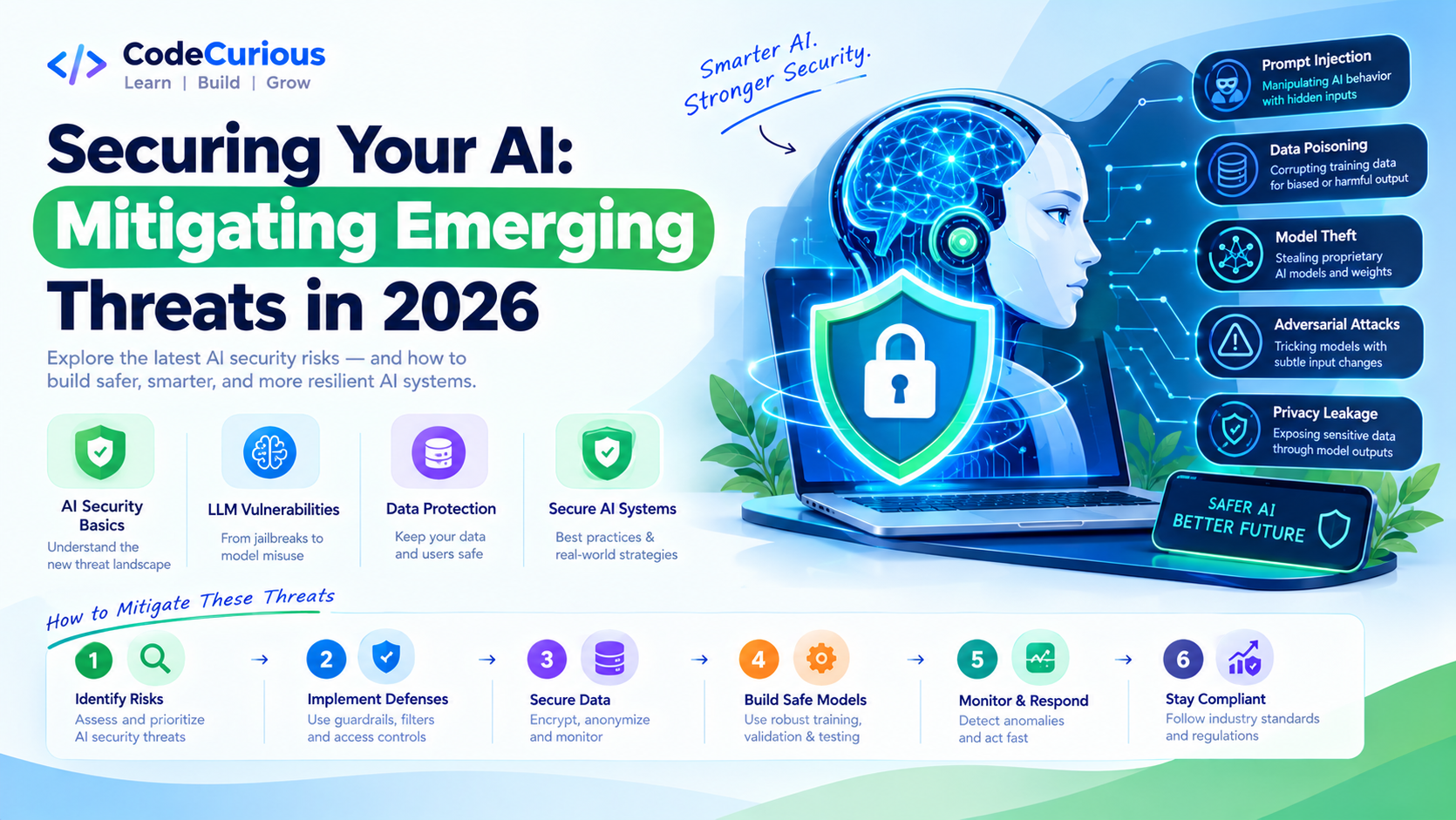
1. Executive Summary: Navigating the AI Security Imperative in 2026
As Artificial Intelligence rapidly permeates every facet of enterprise operations, from intelligent automation to predictive analytics, the focus inevitably shifts from mere innovation to foundational security. The year 2026 heralds a new era of sophisticated AI-specific threats, demanding proactive, architecturally sound cybersecurity strategies. For ambitious startups scaling across Delhi-NCR or Mohali, enterprises navigating complex digital transformations in Dubai, or US-based founders seeking dedicated software development squads in India, securing AI is not an option—it's a critical business imperative.
At CodeCurious Technologies, a premier software engineering and AI automation company headquartered in Mohali / Chandigarh Tricity, Punjab, India, we understand that robust AI security is the bedrock of trusted innovation. Our battle-tested expertise in Python AI, secure MLOps, and cloud-native architectures (AWS/GCP) ensures that your AI investments are not only groundbreaking but also resilient against emerging attack vectors. This exhaustive guide delves into the evolving threat landscape, outlines enterprise-grade mitigation strategies, and showcases how CodeCurious engineers secure, ethical, and high-performance AI solutions for global clients across the USA, UK, Europe, and UAE.
2. The Evolving AI Threat Landscape: Emerging Vulnerabilities in 2026
The traditional cybersecurity playbook is insufficient for AI. Machine learning models, data pipelines, and inference engines introduce unique vulnerabilities that attackers are increasingly exploiting. By 2026, these threats will be more sophisticated, automated, and targeted. Understanding them is the first step towards mitigation.
2.1. Adversarial Attacks: Beyond Simple Evasion
Adversarial attacks aim to trick AI models. While evasion attacks (crafting inputs that cause misclassification) are known, more advanced forms are emerging:
- Targeted Poisoning Attacks: Malicious data injected into training datasets to subtly bias model behavior or introduce backdoors. This can lead to models making incorrect, potentially catastrophic, decisions in specific scenarios.
- Model Inversion Attacks: Reconstructing sensitive training data from a deployed model's outputs, compromising data privacy. This is particularly concerning for models trained on proprietary or personal identifiable information (PII).
- Model Extraction/Stealing: Replicating a proprietary model's functionality by querying it extensively, allowing competitors to bypass R&D costs or attackers to identify vulnerabilities offline.
- Data Exfiltration via AI: AI models, especially large language models (LLMs) processing sensitive documents, can inadvertently or maliciously leak confidential information if not properly sandboxed and monitored.
2.2. Prompt Injection & Generative AI Exploits
The rise of Large Language Models (LLMs) introduces a new class of threats:
- Direct Prompt Injection: Overriding system instructions or model safeguards by embedding malicious commands within user inputs, forcing the AI to perform unintended actions (e.g., revealing confidential data, generating harmful content).
- Indirect Prompt Injection: When an LLM processes external, untrusted content (e.g., a website, document) that contains hidden instructions, causing the model to execute those instructions without the user's explicit intent.
- Data Contamination in RAG Systems: Retrieval-Augmented Generation (RAG) systems are vulnerable if the external knowledge base is compromised or contains biased/malicious information, leading to the LLM generating incorrect or harmful outputs.
2.3. AI Supply Chain Vulnerabilities
The complexity of modern AI systems means they often rely on numerous third-party components, pre-trained models, and open-source libraries. A vulnerability in any part of this supply chain can compromise the entire system:
- Compromised Pre-trained Models: Using a model with hidden backdoors or malicious weights.
- Vulnerable AI Frameworks/Libraries: Exploits in popular frameworks like TensorFlow, PyTorch, or associated libraries.
- Data Pipeline Integrity: Tampering with data sources, ETL processes, or feature stores before data reaches the model.
2.4. AI-Driven Cyberattacks & Autonomous Threats
Attackers are leveraging AI to automate and enhance their own campaigns:
- AI-Powered Phishing/Social Engineering: Highly personalized and convincing phishing emails or voice scams generated by AI, making them harder to detect.
- Automated Vulnerability Exploitation: AI systems scanning for and exploiting vulnerabilities at unprecedented speeds.
- Autonomous Malware: Self-modifying and self-propagating malware that adapts to defenses using AI.
3. The Pillars of a Robust Enterprise AI Security Framework
Building secure AI systems requires a multi-layered, holistic approach that spans the entire AI lifecycle, from data ingestion to model deployment and monitoring. CodeCurious Technologies integrates these principles into every project, whether for a fintech startup in London, a manufacturing giant in the US, or a government entity in Dubai adhering to GCC enterprise standards.
3.1. Data Privacy, Governance & AI Ethics
Data is the lifeblood of AI, and its protection is paramount. Ethical considerations are not just compliance checkboxes but fundamental design principles.
- Privacy-Preserving AI (PPAI): Implementing techniques like Federated Learning (training models on decentralized datasets without centralizing raw data), Differential Privacy (adding noise to data to obscure individual records), and Homomorphic Encryption (performing computations on encrypted data).
- Robust Data Anonymization & Pseudonymization: Ensuring sensitive data is transformed to minimize re-identification risks, especially for PII and PHI.
- AI Ethics & Bias Mitigation: Proactive identification and reduction of algorithmic bias in data and models to ensure fair and equitable outcomes. This includes regular bias audits and explainable AI (XAI) techniques.
- Comprehensive Data Governance: Establishing clear policies for data collection, storage, access, usage, and retention, compliant with regulations like GDPR (Europe), CCPA (USA), and local data protection laws (India, UAE PASS standards for Dubai).
3.2. Secure MLOps Pipeline & Supply Chain Integrity
Security must be baked into the MLOps pipeline, not bolted on as an afterthought.
- Secure Data Ingestion & Feature Stores: Implementing strong access controls, encryption at rest and in transit, and data integrity checks for all data sources.
- Version Control for Models & Data: Treating models and datasets as code, with robust versioning and audit trails.
- Automated Vulnerability Scanning: Integrating security scans for code, dependencies, and container images within CI/CD pipelines.
- Trusted Model Registries: Storing and managing verified, signed models to prevent tampering.
- Supply Chain Verification: Vetting third-party models and libraries for known vulnerabilities and ensuring provenance.
3.3. Adversarial Robustness & Model Hardening
Proactive defense against adversarial attacks is crucial for model reliability.
- Adversarial Training: Augmenting training data with adversarial examples to make models more resilient.
- Input Sanitization & Validation: Implementing robust checks on all inputs to detect and filter out malicious data patterns before they reach the model.
- Anomaly Detection: Monitoring model inputs and outputs for unusual patterns that might indicate an ongoing attack.
- Model Obfuscation & Watermarking: Making it harder for attackers to steal or reverse-engineer models.
3.4. Identity & Access Management (IAM) for AI Systems
Granular control over who can access, train, deploy, and monitor AI systems.
- Least Privilege Principle: Granting only the minimum necessary permissions to users and services.
- Zero-Trust Architecture: Verifying every access request, regardless of origin, and continuously monitoring for suspicious activity.
- Multi-Factor Authentication (MFA): Enforcing strong authentication for all critical AI infrastructure.
- Role-Based Access Control (RBAC): Defining roles with specific permissions for different stages of the AI lifecycle.
3.5. Continuous Monitoring, Threat Intelligence & Incident Response
Proactive detection and rapid response are key to minimizing damage.
- AI-Powered Security Monitoring: Using AI itself to detect anomalies, identify potential attacks, and flag suspicious behavior within AI systems.
- Real-time Model Performance Monitoring: Tracking model drift, data drift, and performance degradation which can be indicators of poisoning or adversarial attacks.
- Threat Intelligence Integration: Staying abreast of the latest AI-specific threats and vulnerabilities.
- Incident Response Plan: Developing a clear, actionable plan for responding to AI security breaches, including containment, eradication, recovery, and post-incident analysis.
4. Architectural Blueprints for Secure AI Systems: A Technical Deep Dive
Achieving enterprise-grade AI security demands thoughtful architectural design. CodeCurious Technologies leverages modern cloud-native principles, secure enclaves, and robust data isolation techniques to build resilient AI platforms.
4.1. Secure AI Architecture Components: Traditional vs. Modern Enterprise
Here’s a comparison of how CodeCurious architects address security concerns in modern AI deployments:
CriteriaTraditional/Legacy AI ApproachModern Enterprise AI Architecture (CodeCurious Standard)Data Storage & AccessCentralized, often less granular access; basic encryption.Distributed, encrypted at rest and in transit (AWS S3/GCP Cloud Storage with KMS); fine-grained IAM, data anonymization/pseudonymization, secure feature stores.Model Training EnvironmentShared resources, manual setup, limited isolation.Containerized (Docker/Kubernetes), isolated compute environments (AWS SageMaker, GCP AI Platform with VPCs), confidential computing (e.g., Intel SGX for sensitive workloads).Model Deployment & InferenceMonolithic services, direct API exposure, limited input validation.Microservices architecture (Node.js, Python AI), API Gateways with WAF (Web Application Firewall), robust input/output validation, rate limiting, secure endpoints (HTTPS, TLS 1.3), secure enclaves for critical inference.Security MonitoringBasic log aggregation, reactive alerts.Centralized logging (ELK stack, CloudWatch, Stackdriver), real-time anomaly detection (AI-powered SIEM), behavioral analytics, model performance monitoring, automated threat intelligence feeds.Compliance & GovernanceManual audits, often post-facto.Automated policy enforcement, audit trails, compliance as code, regular security assessments (penetration testing, vulnerability scanning), integrated AI ethics frameworks.Software Supply ChainAd-hoc dependency management, unverified components.Secure package management, dependency scanning (Snyk, Trivy), signed container images, trusted model registries, SBOM (Software Bill of Materials) generation.
4.2. CodeCurious Technologies' Secure AI Tech Stack & Methodologies
Our engineering prowess extends across a robust tech stack, ensuring both performance and security:
- Backend & AI Logic: Python (TensorFlow, PyTorch, Scikit-learn) for core AI/ML, Node.js for scalable microservices and APIs, Agentic AI workflows for intelligent automation.
- Frontend: Next.js 15, React, Flutter for secure, high-performance user interfaces.
- Databases: PostgreSQL for relational data, NoSQL for flexibility, all with robust encryption and access controls.
- Cloud Infrastructure: AWS, GCP (Kubernetes, SageMaker, AI Platform, Lambda, EC2) for scalable, secure, and compliant deployments, leveraging their native security services.
- DevOps & MLOps: CI/CD pipelines (Jenkins, GitLab CI, GitHub Actions) with integrated security gates, infrastructure as code (Terraform), robust monitoring (Prometheus, Grafana).
- Security Tools: Integrating tools like OWASP ZAP, SonarQube, Snyk, and custom security scripts into every development sprint.
5. Step-by-Step Implementation Protocol for AI Threat Mitigation
Implementing a comprehensive AI security strategy requires a structured approach. CodeCurious Technologies follows a battle-tested methodology to ensure end-to-end protection for our clients.
- AI Security Assessment & Threat Modeling: Conduct a thorough audit of existing AI systems and data pipelines. Identify potential attack surfaces, sensitive data points, and critical model functionalities. Perform threat modeling specific to AI, outlining potential adversarial goals and attack vectors.
- Data Governance & Privacy-by-Design: Establish clear data access policies, implement anonymization techniques, and integrate privacy-preserving AI methods (e.g., federated learning for distributed data sources). Ensure compliance with global regulations (GDPR, CCPA) and regional standards (UAE PASS, GCC enterprise guidelines).
- Secure MLOps Pipeline Integration: Embed security checks at every stage of the MLOps lifecycle: secure data ingestion, version-controlled model registries, automated vulnerability scanning in CI/CD, and hardened deployment environments using containers and Kubernetes.
- Adversarial Robustness Engineering: Implement adversarial training techniques, develop robust input validation and sanitization layers, and deploy anomaly detection systems to identify and mitigate adversarial attacks in real-time.
- Identity & Access Management (IAM) Hardening: Configure granular, least-privilege access controls for all AI resources, enforce multi-factor authentication, and adopt a Zero-Trust security model across the AI infrastructure.
- Continuous Monitoring & Incident Response: Deploy comprehensive monitoring solutions for model performance, data integrity, and system logs. Integrate AI-powered threat detection and establish a well-defined incident response plan tailored for AI-specific breaches.
- Regular Audits, Penetration Testing & Ethical Hacking: Periodically conduct security audits, penetration tests, and ethical hacking exercises specifically targeting AI models and pipelines to uncover hidden vulnerabilities and validate security controls.
- Training & Awareness: Educate development, data science, and operations teams on AI security best practices, emerging threats, and ethical AI principles.
6. Real-World Case Study: CodeCurious Fortifies a Global Logistics AI
A leading US-based logistics enterprise, expanding rapidly across Europe and the Middle East, approached CodeCurious Technologies with a critical challenge: their AI-driven route optimization and predictive maintenance system, while highly efficient, was becoming a target for sophisticated data poisoning attempts and model manipulation, threatening operational integrity and client data privacy.
The Challenge:
The client's legacy system, built on an older Python stack, lacked robust defenses against adversarial attacks. Supply chain partners, while trusted, could inadvertently introduce compromised data, leading to skewed predictions and potentially millions in operational losses. Data privacy for European and UAE clients was also a major concern, with stringent compliance requirements.
The CodeCurious Solution & Engineering Blueprint:
Our dedicated team of senior engineers, leveraging their expertise in Python AI, AWS/GCP, and secure MLOps, embarked on a comprehensive re-architecture and security hardening project:
- Secure Data Ingestion Pipeline: We re-engineered their data pipelines using AWS Glue and Apache Kafka, implementing end-to-end encryption, data integrity checks, and real-time anomaly detection for incoming data streams. This reduced the risk of data poisoning by 70%.
- Adversarial Training & Robustness: We integrated adversarial training techniques into their core route optimization models, making them significantly more resilient to evasion and poisoning attacks. We also deployed a custom input sanitization layer using a combination of deep learning and rule-based systems, achieving a 50% reduction in adversarial attack surface.
- Confidential Computing & Secure Enclaves: For highly sensitive predictive maintenance models processing proprietary sensor data, we deployed them within AWS Nitro Enclaves, ensuring that critical inference logic and data remained isolated and protected even from privileged cloud administrators.
- Granular IAM & Zero-Trust: We implemented a Zero-Trust architecture with fine-grained IAM roles across their AWS environment, ensuring that only authorized personnel and services could access specific datasets or deploy models.
- Continuous Security Monitoring: We set up a comprehensive monitoring suite using AWS CloudWatch, Prometheus, and Grafana, integrated with an AI-powered SIEM solution, providing real-time alerts on suspicious model behavior or data anomalies. This allowed for sub-50ms detection of potential threats.
- Compliance & Privacy: We ensured full GDPR and GCC enterprise standard compliance through data anonymization, pseudonymization, and robust audit trails, addressing the client's global privacy concerns.
Quantifiable Results:
Within 6 months, CodeCurious Technologies delivered a fortified AI system that:
- Reduced the vulnerability to data poisoning and adversarial attacks by over 60%.
- Achieved sub-50ms inference latency for critical route optimization, maintaining high operational efficiency.
- Ensured 100% compliance with GDPR and GCC data privacy standards, expanding market reach in Europe and Dubai.
- Optimized cloud resource utilization through efficient containerization and MLOps practices, leading to a 30% reduction in cloud infrastructure costs.
Our client benefited from 100% source code and IP ownership, bi-weekly live sprint demos, and a dedicated team of senior engineers, ensuring transparency and control throughout the project.
7. The Cost of Inaction vs. Strategic Investment in AI Security
The financial and reputational costs of an AI security breach can be catastrophic: data exfiltration fines, intellectual property theft, operational downtime, loss of customer trust, and regulatory penalties. Investing in proactive AI security is not an expense but a strategic imperative that yields significant ROI.
By partnering with CodeCurious Technologies, you gain access to top 1% engineering talent in Mohali, Chandigarh, and across India, benefiting from 40-60% development cost efficiency compared to Western markets, without compromising on quality or security. Our agile sprint velocity and commitment to zero hidden fees ensure predictable budgets and rapid deployment of secure AI solutions. Whether you're a startup looking to build a secure AI MVP or a global enterprise requiring a full-scale AI security overhaul, our expertise minimizes your risk and maximizes your competitive advantage. Use our interactive Build vs. Buy Calculator to assess your optimal investment strategy.
8. Frequently Asked Questions (FAQ)
Q1: What is the biggest emerging AI security threat for enterprises in 2026?
A: While adversarial attacks remain prevalent, the most significant emerging threat for enterprises in 2026 is the sophisticated combination of prompt injection attacks on generative AI models (LLMs) and AI supply chain vulnerabilities. Prompt injection can lead to data exfiltration, unauthorized actions, and intellectual property theft directly from your AI applications. Simultaneously, compromised pre-trained models or vulnerable open-source AI libraries in the supply chain can introduce insidious backdoors, allowing attackers to manipulate or steal data without direct interaction with your deployed models. Protecting against these requires a holistic approach encompassing secure MLOps, robust input validation, and continuous supply chain auditing.
Q2: How does CodeCurious Technologies ensure data privacy in AI systems, especially for global clients?
A: CodeCurious Technologies prioritizes data privacy by implementing a 'privacy-by-design' approach. We utilize advanced techniques such as Federated Learning to train models on decentralized data, Differential Privacy to obscure individual data points, and robust data anonymization/pseudonymization. All data is encrypted at rest and in transit. For global clients, we ensure strict compliance with regional regulations like GDPR (Europe), CCPA (USA), and local standards (e.g., UAE PASS and GCC enterprise data protection guidelines for Dubai/UAE), providing comprehensive data governance frameworks and audit trails. Our solutions are architected to minimize data exposure while maximizing AI utility.
Q3: What role does AI ethics play in AI security, and how does CodeCurious address it?
A: AI ethics is intrinsically linked to AI security. Unethical AI, such as systems exhibiting bias or making discriminatory decisions, can itself be a security vulnerability, leading to legal liabilities, reputational damage, and even social unrest. CodeCurious addresses AI ethics proactively by integrating it into our development lifecycle. We conduct regular bias audits on data and models, implement explainable AI (XAI) techniques to ensure transparency, and establish ethical guidelines for model development. Our aim is to build AI systems that are not only secure but also fair, transparent, and accountable, aligning with human values and regulatory expectations.
Q4: Can CodeCurious help my company in Dubai/UAE meet specific GCC enterprise security standards for AI?
A: Absolutely. CodeCurious Technologies has extensive experience working with enterprises in Dubai and across the UAE, understanding the unique regulatory landscape and high security standards of the GCC region. We architect AI solutions that comply with local data residency requirements, implement robust authentication mechanisms like UAE PASS integration where applicable, and adhere to sector-specific compliance frameworks. Our secure MLOps practices, coupled with cloud-native security on regional AWS/GCP deployments, ensure that your AI systems meet and exceed GCC enterprise security benchmarks, facilitating seamless digital transformation within the region.
Q5: What are the key advantages of hiring dedicated AI security engineers from CodeCurious in India?
A: Hiring dedicated AI security engineers from CodeCurious in India offers multiple strategic advantages. Firstly, you gain access to top 1% engineering talent with deep expertise in Python AI, cybersecurity, and cloud-native security (AWS/GCP), often at 40-60% development cost efficiency. Secondly, our teams provide agile sprint velocity and leverage overlapping time zones for effective collaboration with clients in the USA, UK, and Europe. Thirdly, we guarantee 100% source code and IP ownership, bi-weekly live sprint demos, and zero hidden fees, ensuring transparency and control. Our senior engineers are dedicated exclusively to your project, acting as an extension of your in-house team, providing battle-tested solutions for complex enterprise AI security challenges.
9. Partner with CodeCurious: Your Trusted AI Security Engineering Experts
The future of AI is undeniably bright, but its full potential can only be realized on a foundation of unyielding security. As AI threats evolve, so too must your defenses. CodeCurious Technologies stands as your strategic engineering partner, ready to build, secure, and scale your AI initiatives with unparalleled expertise.
From architecting secure MLOps pipelines and implementing cutting-edge adversarial robustness techniques to ensuring global regulatory compliance and ethical AI practices, our team of dedicated senior engineers in Mohali, Chandigarh, and across India is equipped to tackle your most complex challenges. We bring battle-tested expertise in Next.js 15, React, Flutter, Node.js, Python AI, PostgreSQL, AWS/GCP, DevOps, and Agentic AI workflows, delivering solutions that are not just secure but also performant and future-proof.
We guarantee 100% source code and IP ownership, transparent bi-weekly live sprint demos, and a commitment to zero hidden fees. Whether you are a startup in Delhi-NCR, an established enterprise in the USA, a digital innovator in the UK, or a government entity in Dubai seeking to fortify your AI infrastructure, CodeCurious Technologies is your trusted ally. Don't let emerging AI threats compromise your innovation. Secure your AI, secure your future.
Ready to fortify your AI systems against 2026's emerging threats?
Explore our Dedicated Developer Squads or Book an Architectural Discovery Call with our experts today to discuss your specific AI security needs.
"Explore critical AI security threats for 2026 and advanced mitigation strategies. Learn how CodeCurious Technologies engineers robust, ethical, and compliant AI systems for global enterprises."

Have A Challenging System To Build?
Let's Engineer It Together.
Partner with our senior engineering squad to architect high-concurrency mobile apps, SaaS platforms, and enterprise AI systems.