An unbiased deep-dive comparing React Native with the New Fabric Architecture against Flutter with the Impeller rendering engine. Which framework wins for your 2026 project?
1. The 2026 Landscape: How Both Frameworks Eliminated the Bridge
In previous years, cross-platform apps suffered from "bridge serialization" bottlenecks whenever complex animations crossed from JavaScript/Dart to native iOS/Android views. In 2026, both frameworks have fundamentally rewritten their rendering cores.
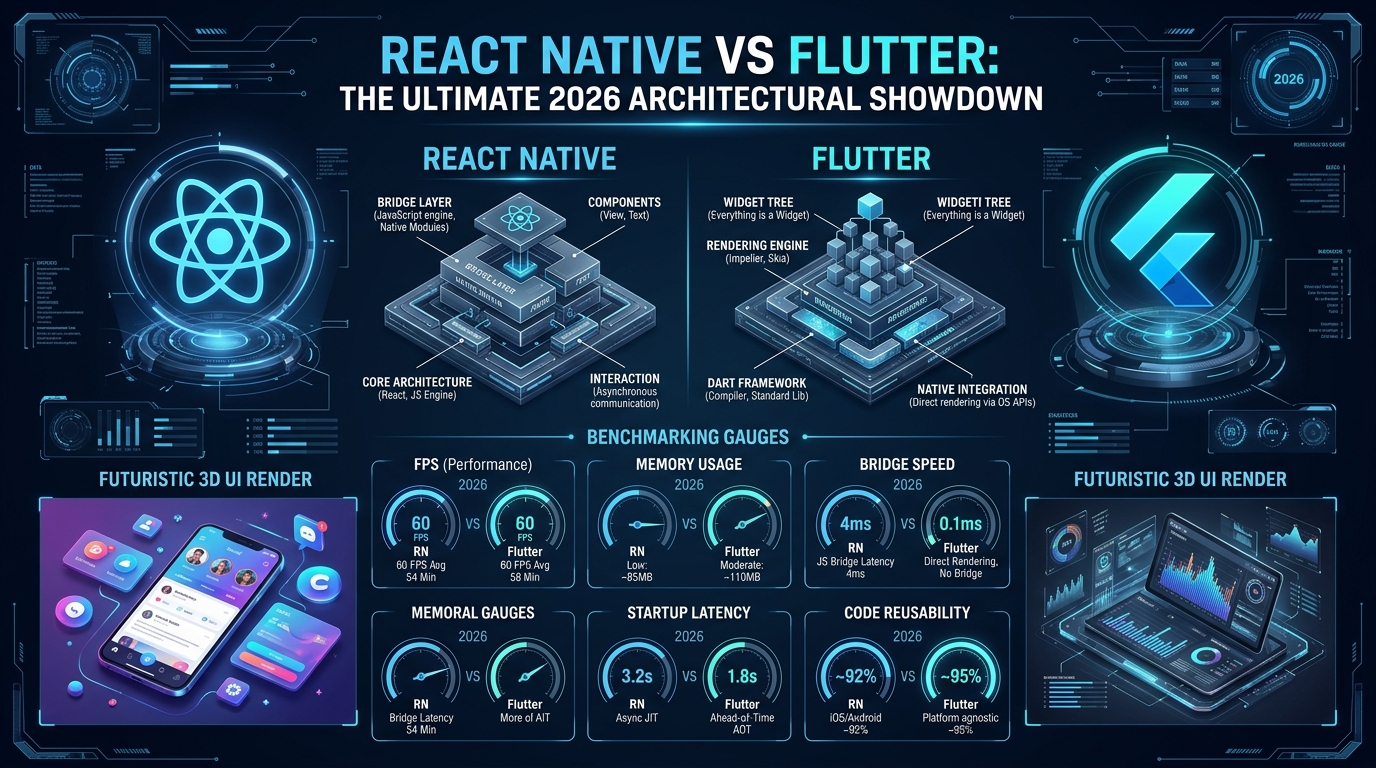
React Native introduced the New Architecture with Fabric rendering and TurboModules using JSI (JavaScript Interface), allowing direct synchronous C++ memory access. Meanwhile, Flutter rolled out Impeller, completely replacing Skia to precompile shaders ahead of time (AOT) and eradicate shader compilation jank on iOS and Android.
2. Deep Performance Benchmarks: FPS, Startup Time & Memory
| Benchmark Metric | React Native (New Arch) | Flutter (Impeller) | Architectural Winner |
|---|---|---|---|
| Average Frame Rate (FPS) | 58–60 FPS | 60 FPS (Stable) | Flutter (Smoother complex canvas) |
| Cold Startup Time | 2.1s (Hermes Engine) | 1.6s (AOT Binary) | Flutter (24% Faster Cold Boot) |
| Memory Overhead | 82 MB Baseline | 95 MB Baseline | React Native (14% Less RAM) |
| Over-The-Air (OTA) Updates | Native Support (CodePush) | Restricted on iOS | React Native (Instant bug hotfixes) |
Frequently Asked Questions
Which framework should I choose for an MVP in 2026?
▾
Choose React Native if your team already knows React/TypeScript and you plan to share code with a Next.js web application. Choose Flutter if you want gorgeous 60fps animations, custom UI canvases, and a single unified Dart codebase.
![How Much Does It Cost to Build an App in India? [2026 Complete Guide]](../assets/blog-app-cost.jpg)