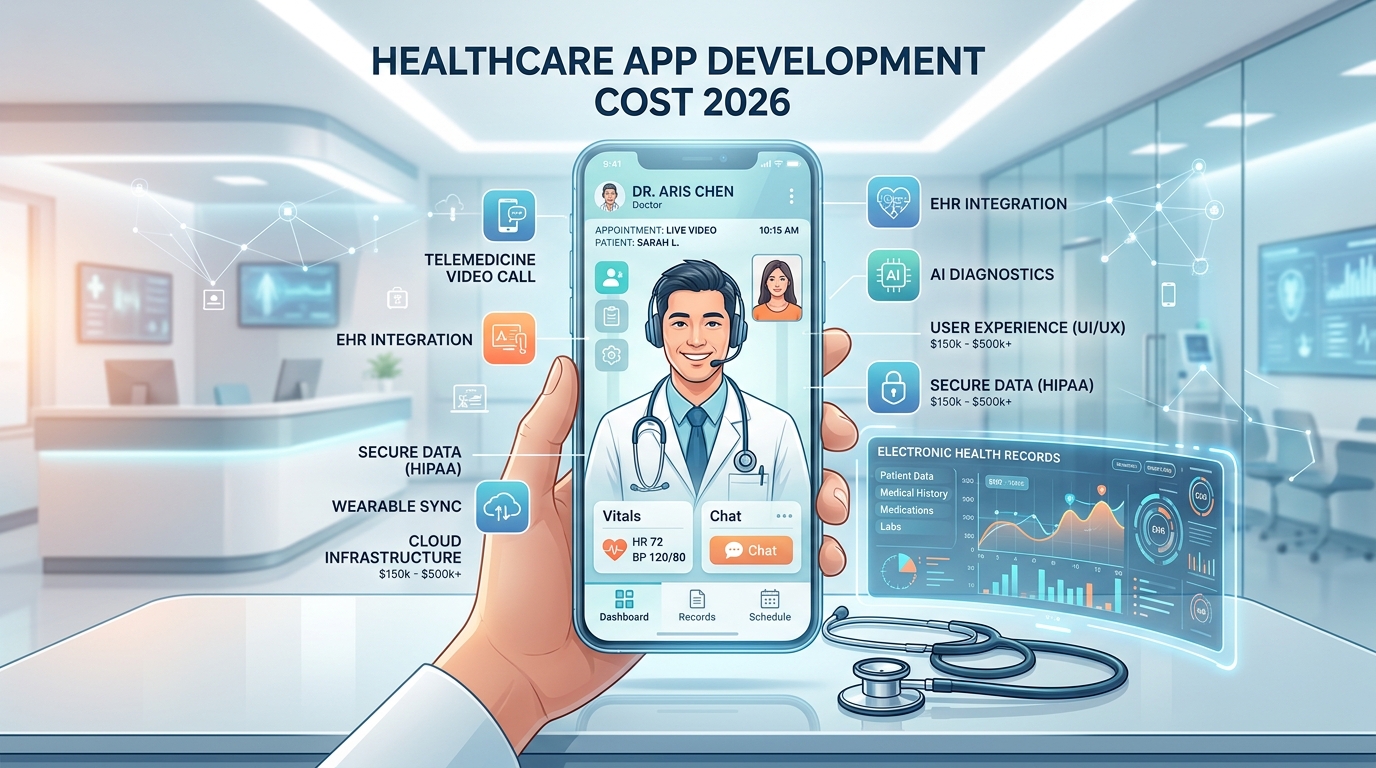
1. Executive Summary: The Cost of Building a Healthcare App in 2026
The global digital health and telemedicine market is expanding at an unprecedented rate. In India, building a HIPAA-compliant, production-grade healthcare application costs between ₹4,50,000 ($5,500 USD) for an initial doctor-patient appointment MVP and ₹25,00,000+ ($30,000+ USD) for full-scale hospital network management suites with EHR synchronization and AI diagnostics.
By partnering with an experienced engineering agency like CodeCurious Healthcare Practice, healthcare providers and health-tech founders achieve top-tier clinical UX and security at approximately 25% to 30% of US or UK agency rates.
| App Complexity Tier | Key Scope & Features | Estimated Cost (INR / USD) | Timeline |
|---|---|---|---|
| Basic Doctor Appointment MVP | Doctor profiles, calendar scheduling, audio consults, basic prescriptions, UPI/card payments. | ₹4.5L – ₹7.5L ($5.5K – $9K USD) | 6 – 8 Weeks |
| Telemedicine & Video Suite | Encrypted HD WebRTC video, e-prescriptions, live vitals telemetry, patient medical record vault. | ₹8.5L – ₹15.5L ($10K – $18.5K USD) | 10 – 14 Weeks |
| Enterprise Hospital EHR / PACS | HL7/FHIR EHR bidirectional sync, pharmacy dispatch, multi-clinic routing, AI anomaly detection. | ₹16.5L – ₹28.5L+ ($20K – $35K+ USD) | 16 – 22 Weeks |
2. Key Types of Healthcare Apps & Their Market Demand
Depending on your clinical workflow and target audience, healthcare applications fall into four major categories:
- Doctor-on-Demand & Telehealth Apps: Real-time patient triage, secure WebRTC video consultations, digital prescription distribution, and instant doctor payout reconciliation (e.g., Practo, Teladoc).
- Hospital Management & Patient Portals (EHR/EMR): Centralized patient electronic health records, lab test booking, digital radiology viewer integration, and multi-department billing.
- Chronic Disease & Vitals Monitoring (IoT/RPM): Bluetooth-connected glucometers, ECGs, blood pressure cuffs, and automated SOS emergency triggers.
- E-Pharmacy & Diagnostic Lab Booking: Upload prescription OCR parsing, medicine delivery dispatch, home sample collection slotting, and automated inventory sync.
3. Core Features That Determine Engineering Costs
A high-converting healthcare application requires three distinct interfaces working in harmony:
A. Patient Mobile App (iOS & Android)
- Biometric Login & KYC: FaceID / Fingerprint login with OTP verification.
- Smart Doctor Discovery: Filter by specialty, consultation fees, clinic location, languages, and patient reviews.
- Encrypted Video Consultation: Sub-second WebRTC video calls with in-call chat, screen sharing, and document uploads.
- Digital Medical Locker: Upload, organize, and share past lab reports, MRI scans, and immunization history securely.
B. Doctor Consultation Workstation (Web & Tablet)
- Interactive Appointment Calendar: Manage physical and virtual appointment queues seamlessly.
- Digital Prescription Pad: Pre-filled medicine database with automated dosage alerts and e-signature generation.
- EHR Access: View historical patient vitals and past doctor consultation notes during live calls.
C. Hospital & Super-Admin Portal
- Doctor Verification: Verify medical council registration credentials (MCI/NMC) before onboarding.
- Payment & Commission Settlement: Automated commission splitting, refunds, and merchant payouts.
- Audit Trails & Compliance Telemetry: Complete immutable logs of patient record access.
🔒 Critical Compliance Note: HIPAA & Indian DISHA Standards
Healthcare applications cannot use standard unsecured databases. They must implement AES-256 data-at-rest encryption, TLS 1.3 in-transit encryption, and store health data within certified Indian VPC datacenters (for Indian DISHA compliance) or HIPAA-compliant AWS/GCP regions for global clients. CodeCurious builds every health-tech app with zero-trust security architecture.
4. Feature-by-Feature Development Cost & Module Breakdown
Here is how individual engineering modules, compliance frameworks, and infrastructure components contribute to your total development budget:
FaceID/TouchID biometrics, JWT session tokens, 2FA SMS/WhatsApp OTP, and strict permission segregation between patients, doctors, and nurses.
Sub-400ms peer-to-peer and SFU video conferencing, in-call interactive chat, screen sharing for scan reviews, and auto-bandwidth fallback.
Real-time calendar slot booking, instant token generation, automated delay notifications, and multi-clinic doctor availability sync.
Pre-loaded ICD-10 drug database, automated dosage conflict alerts, cryptographic e-signature, and instant WhatsApp/PDF dispatch.
FHIR/HL7 compliant patient records vault, lab report OCR parsing, DICOM radiology viewer, and Ayushman Bharat Health Account (ABHA) integration.
Sub-second UPI 2.0 payments, health insurance TPA pre-authorization workflows, automated doctor commission splitting, and refunds.
5. Frequently Asked Questions (FAQ)
Q1: Which framework is best for building a healthcare mobile app?
We strongly recommend Google Flutter. A single Dart codebase compiles natively for iOS and Android, saving 40% in initial development and testing costs while providing the 60 FPS performance necessary for real-time video consultations.
Q2: Do we own the source code upon delivery?
Yes. Upon completion of project milestones, 100% of the source code, IP rights, database schemas, and cloud deployment scripts belong exclusively to you with zero recurring proprietary vendor lock-in.
Q3: How do we get started with CodeCurious?
You can schedule a free architecture consultation. Our engineering leads will review your clinical requirements, map out a feature matrix, and provide a fixed-cost milestone estimate within 24 hours.
Ready to Build Your Healthcare App?
Get a detailed clinical feature blueprint, compliance audit, and transparent milestone quote customized for your healthcare platform.
Get Free Custom Quote ➔