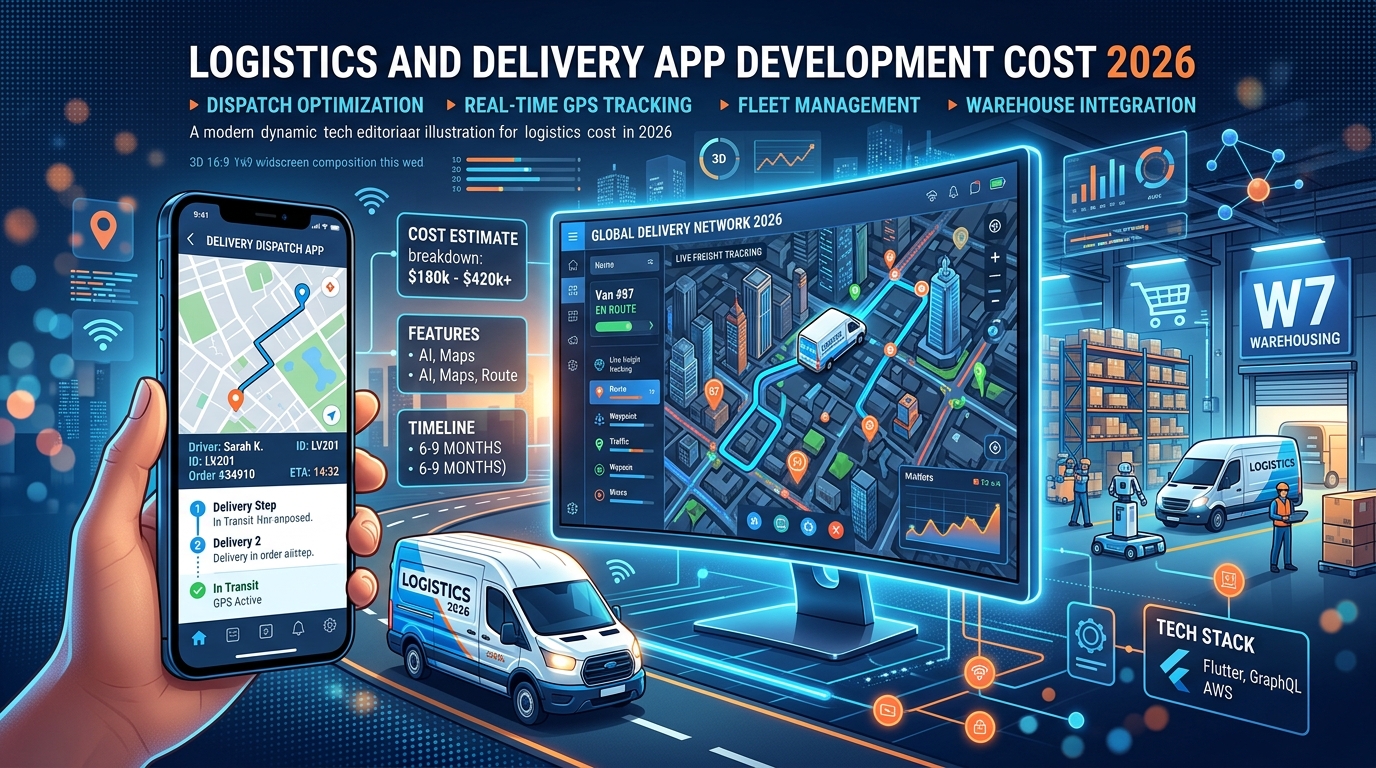
1. Executive Summary: The Cost to Build a Logistics App in 2026
The logistics and delivery market in India and globally has evolved beyond simple parcel tracking. Modern supply chain platforms require automated dispatch routing, driver battery-optimized GPS tracking, proof of delivery (PoD), and live telemetry.
In 2026, building a custom logistics and delivery platform in India costs between ₹4,00,000 ($4,800 USD) for an MVP courier tracking app and ₹20,00,000+ ($24,000+ USD) for high-concurrency multi-city enterprise fleet management ERPs.
| Platform Tier | Key Capabilities | Estimated Cost | Timeline |
|---|---|---|---|
| On-Demand Courier MVP | Customer booking app, driver partner app, basic Google Maps routing, manual dispatch. | ₹4.5L – ₹7.5L ($5.5K – $9K USD) | 6 – 8 Weeks |
| Hyperlocal Delivery System (3 Apps) | Customer app, Driver app, Merchant portal, automated 4s driver matching, e-signatures. | ₹8.5L – ₹14.5L ($10K – $17.5K USD) | 10 – 14 Weeks |
| Enterprise Freight Telematics ERP | IoT GPS sensor integration, fuel theft alerts, automated multi-state billing, toll calculations. | ₹16.5L – ₹25L+ ($20K – $30K+ USD) | 16 – 22 Weeks |
2. The 3-Sided App Architecture Explained
Unlike simple social apps, logistics software requires three interconnected applications synchronized via WebSockets:
- 1. Customer / Shipper Mobile App: Order placement, instant freight quotes, live Mapbox vehicle tracking, ETA push notifications, and cashless checkout.
- 2. Driver & Delivery Partner App: Broadcast job alerts with accept/reject timers, turn-by-turn navigation, digital proof of delivery (photo + e-signature), and earnings wallet.
- 3. Dispatch Central Super-Admin ERP: Live fleet bird's eye map view, geofence auto-assignment, driver compliance verification, and fuel consumption analytics.
3. High-Value Technical Modules That Drive ROI
When building with CodeCurious Logistics Engineering, we implement key high-performance features:
- Battery-Optimized GPS Tracking: Adaptive location pinging reduces driver smartphone battery drain by 45%.
- Dynamic Route Optimization: Solves the Traveling Salesperson Problem (TSP) to calculate multi-drop delivery sequences, reducing fuel costs by up to 35%.
- Offline-First Resilience: Drivers in remote rural zones can scan barcodes and collect digital signatures offline, auto-syncing when internet connectivity restores.
5. Detailed Module-by-Module Development Cost Breakdown
Each layer of a 3-sided supply chain architecture requires distinct engineering specializations:
Battery-efficient background GPS tracking (3s ping interval), turn-by-turn navigation, geofence enter/exit triggers, and dynamic ETA estimation.
Hungarian matching algorithm for optimal driver allocation, multi-stop route clustering, and load capacity optimization.
Single-tap order acceptance, offline mode sync, digital proof of delivery (camera photo & e-sign), and real-time wallet earnings payout.
Bulk CSV shipment upload, automated AWB barcode generator, live courier tracking widgets, and invoice billing management.
OBD-II CAN bus integration, vehicle diagnostics, harsh braking alerts, engine idle monitors, and refrigerated cargo temperature alerts.
Live interactive geospatial fleet map, driver KYC verification, automated commission reconciliation, and SLA breach heatmaps.
5. Frequently Asked Questions (FAQ)
Q1: Which map provider is most cost-effective for delivery apps?
While Google Maps is widely known, Mapbox or OpenStreetMap offers up to 60% lower API costs at scale while providing superior customizable vector tile rendering.
Q2: How fast can CodeCurious launch our delivery app?
A functional MVP can be delivered in 6 to 8 weeks with complete production code, automated CI/CD pipelines, and app store publishing.
Scale Your Logistics Business in 2026
Get a custom logistics architecture blueprint, live GPS demo, and transparent milestone quote within 24 hours.
Get Free Logistics Quote ➔